
Who should pay this bill? [EN/PT]

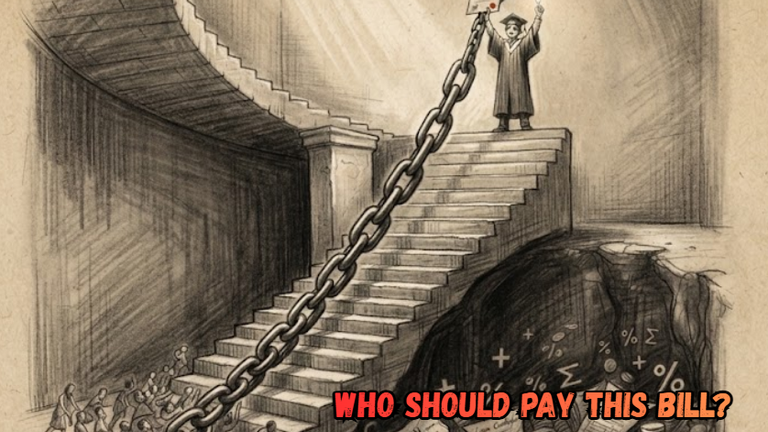
We can say that studying has always been seen as one of the best ways to try to build a better life. After all, when a person gets a good education, their chances of finding a better job and increasing their income can grow considerably. The problem is that, in many places, studying also means taking on a huge debt before even starting a professional career. So-called "student loans" can follow a person for decades, while interest continues to increase and turn a dream into an obligation that is difficult to escape. I have personally been through moments when a small debt seemed much bigger than it really was, simply because interest and other expenses caused the amount to grow over time. When we think about someone starting their adult life already carrying a large debt, it is easy to understand why this subject generates so much discussion.
Well, on the other hand, there is a proposal that seems simple when we look only at those who are in debt: forgiving all of these debts. For these people, it would be like finally being able to breathe after years of paying for something that may no longer even be bringing the expected return. Imagine someone who studied, earned their degree, but then spent the next ten or twenty years using part of their salary to pay off a loan. Suddenly, that debt disappears. Of course, this could represent a huge change in that person's life. They could buy a house, invest, help their family, or simply have more peace of mind. The problem is that the debt would not really disappear. Someone would have to pay that bill, and that is exactly where the discussion becomes much more complicated.
If erasing these loans required increasing taxes for the entire population, including people who never went to college or who have already finished paying off their own debts, would that really be fair? This is a question that I find very difficult to answer. Think, for example, about someone who started working at eighteen, never went to college, and spent years paying taxes. They might look at someone who received a university education and now had their entire debt forgiven, while they themselves received no similar benefit. At the same time, we can also think about someone who studied for years, went into debt precisely to try to find better opportunities, and ended up trapped in a debt that seems to have no end. Both sides have arguments that make sense, and perhaps that is exactly why finding a simple solution is so difficult.
Personally, I believe education is something that deserves investment, but that does not mean that every solution is automatically fair. Forgiving debts may help millions of people, but increasing taxes also means taking money from millions of other people. In the end, we are simply changing who pays the bill. Perhaps the real question is how to make education more accessible in the future, so that a person does not have to choose between studying and spending decades paying for it. Because erasing a debt can solve the problem for someone who is already in a hole, but it does not prevent other people from continuing to fall into it. And perhaps that is the most important point in this entire discussion: it is not enough to ask who deserves to have their debt forgiven, we also need to think about how to prevent the same debt from continuing to be created.
Credits:
Translated: Deepl
Cover: created by Canva.
AI-generated image Flow

Podemos dizer que estudar sempre foi visto como uma das melhores formas de tentar construir uma vida melhor. Afinal, quando uma pessoa consegue uma boa formação, suas chances de encontrar um emprego melhor e aumentar sua renda podem crescer bastante. O problema é que, em muitos lugares, estudar também significa assumir uma dívida enorme antes mesmo de começar a vida profissional. Os chamados "student loans" podem acompanhar uma pessoa durante décadas, enquanto os juros continuam aumentando e transformando um sonho em uma obrigação difícil de abandonar. Eu mesmo já passei por momentos em que uma dívida pequena parecia muito maior do que realmente era, simplesmente porque os juros e outras despesas faziam o valor crescer com o tempo. Quando pensamos em alguém começando a vida adulta já carregando uma dívida grande, fica fácil entender por que esse assunto gera tanta discussão.
Bem, por outro lado, existe uma proposta que parece simples quando olhamos apenas para quem está endividado: perdoar todas essas dívidas. Para essas pessoas, seria como finalmente conseguir respirar depois de anos pagando por algo que talvez nem esteja mais trazendo o retorno esperado. Imagine alguém que estudou, conseguiu seu diploma, mas passou os dez ou vinte anos seguintes destinando parte do salário para pagar um empréstimo. De repente, essa dívida desaparece. É claro que isso poderia representar uma mudança enorme na vida dessa pessoa. Ela poderia comprar uma casa, investir, ajudar a família ou simplesmente ter mais tranquilidade. O problema é que a dívida não desapareceria de verdade. Alguém precisaria pagar essa conta, e é justamente aí que a discussão fica muito mais complicada.
Se para apagar esses empréstimos fosse necessário aumentar os impostos de toda a população, inclusive das pessoas que nunca fizeram uma faculdade ou que já terminaram de pagar suas próprias dívidas, será que isso seria justo? Essa é uma pergunta que eu acho muito difícil de responder. Pense, por exemplo, em uma pessoa que começou a trabalhar aos dezoito anos, nunca fez faculdade e passou anos pagando impostos. Ela poderia olhar para alguém que recebeu uma educação universitária e agora teve sua dívida completamente perdoada, enquanto ela mesma não recebeu nenhum benefício semelhante. Ao mesmo tempo, também podemos pensar em alguém que estudou durante anos, se endividou justamente para tentar conseguir melhores oportunidades e acabou preso a uma dívida que parece não ter fim. Os dois lados possuem argumentos que fazem sentido, e talvez seja justamente por isso que uma solução simples seja tão difícil de encontrar.
Particularmente, acredito que educação seja algo que merece investimento, mas isso não significa que qualquer solução seja automaticamente justa. Perdoar dívidas pode ajudar milhões de pessoas, mas aumentar impostos também significa retirar dinheiro de milhões de outras pessoas. No fim, estamos apenas mudando quem paga a conta. Talvez a verdadeira questão seja descobrir como tornar a educação mais acessível no futuro, para que uma pessoa não precise escolher entre estudar e passar décadas pagando por isso. Porque apagar uma dívida pode resolver o problema de quem já está no buraco, mas não impede que outras pessoas continuem caindo nele. E talvez esse seja o ponto mais importante de toda essa discussão: não basta perguntar quem merece ter a dívida perdoada, também precisamos pensar em como evitar que a mesma dívida continue sendo criada.
Credits:
Translated: Deepl
Cover: created by Canva.
AI-generated image Flow
This aligns with my perception too.
Honestly, if everything is going well, I don't think students will have to depend on loans to study..
Hmmm! How to make education more accessable in the future so that students don't go to take a loan because they want what is their basic human rights