
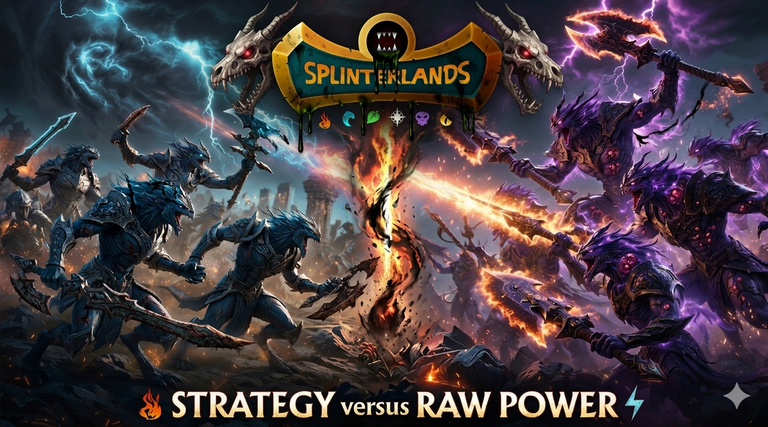
Splinterlands:Strategy Over Raw Power!

Good morning warriors! It is mid-week already,and the battles have started heating up. Welcome to my blog @zusi78.
In the #Splinterlands community, the common sentiment (often phrased as “brain over brawn” or “strategy over raw power”) is that smart team-building, ruleset adaptation, positioning, and synergies usually beat simply owning the strongest or highest-level cards.
Splinterlands is no walk in the park, but that's what amps up the excitement.A winning strategy weighs stats, abilities, rulesets, mana caps, and beyond. That's why you must factor them all into your deck building. Toss in strong cards to boost your setups, and push hard to rack up as many victories as possible! 🔥

Core Gameplay Mechanics Make Skill Matter More
In #Splinterlands,you build a team of up to 6 units (plus a Summoner/Archon) under specific constraints, then watch the battle play out automatically. Key factors include:
Mana Cap: Every battle has a mana limit (e.g, 12–99). You can't just spam expensive, powerful cards—you must optimize a balanced team within the budget. Low-mana "filler" units can serve strategic roles like tanking or sacrificing.
Battle Rules/Modifiers: These change every match (e.g, "Aim True," "Back to Basics," "Melee Mayhem," "Fog of War," etc.).They restrict abilities, targeting, healing, or force specific playstyles. A strong card can become useless or even detrimental under the wrong rules.
Elements and Summoner Choice: Your Summoner determines available elements and often provides buffs/debuffs. Positioning is critical—melee units usually attack from the front unless they have abilities like Sneak, Opportunity, or Reach; ranged/magic have their own rules as well.
Abilities and Interactions: Cards have unique abilities (e.g,Taunt, Heal, Poison, Dodge, Snipe, armored strike, flying etc.) that create complex synergies and counters.Understanding targeting order, buffs/debuffs, and how rules interact is huge.
To validate these claims, here are 4 epic battles that perfectly demonstrate strategy over raw power:
Battle 1,In this very battle the rules are Camouflage and True strike, with a total mana cost of 35,and you are to select splinters from fire, earth,life and dragon.
Here is what happened; After understanding the rulesets,I built a perfect counter: a "heal wall" that laughs at burst.
Meriput Magician (hidden by camouflage)as MVP shows how a "lowly" common with the right ability + ruleset interaction can outperform legendaries.My Opponent had the flashier team (Resurgence revives, big Ape tank), but I had the better plan.
Start of Battle.
End of Battle. Watch the replay
Battle 2 In this battle the rulesets are heavy hitters and eggceleration(grants +1 to all units stats at the end of each round).This was a high mana battle the total mana cost was 53,and you are to choose splinters from fire, earth,life and dragon.Without further ado,the twist here was using Eternal Tofu's flexibility for Earth + Life tank healers(two healers)+ Divine Shield on the tank — was the decisive factor. Opponent's burst couldn't overcome the steady, massive HP restoration + shields + thorns/snare slowing them down.
Start of Battle
End of Battle Watch the replay
These remaining 3 battles showcase my most common strategy, which prioritizes synergy over raw power. It features the strong Elowen Sylphie trio synergy with Skrag the Gnaw(delivers poison burst, the game changer) and Thanalorian Blade. My win rate with this setup is 80%. Happy viewing!
Battle 3 Watch the replay
Battle 4 Watch the replay
Battle 5 Watch the replay
My final thoughts 💬
#Splinterlands rewards skill — card collection gets you in the door, but lineup building and adaptation win games.Raw Power (stats, levels, revives, big health pools) wins many matches in neutral conditions, but Strategy (ruleset reading, synergy, positioning, counter-play) wins in Ranked/competitive play.
Splinterlands is a fun game.If you haven’t joined yet, here’s my referral link to participate:
Join
Thank you for reading and watching my post. @zusi78 signing off.

Sending you Ecency curation votes.😉

You have lovely archon my friend.
!PIZZA
Thank you so much Sir,That is one way to survive at the top,some good Archons. I really appreciate you for taking your time to stop by as well as the votes 🙏.
$PIZZA slices delivered:
@ekavieka(5/5) tipped @zusi78
Please vote for pizza.witness!