
From the romance of the phone booth to the silence of a chat room.

To be born in Venezuela in the 1950s was to witness a country transforming at the pace of oil and modernity. For those of us who have crossed the six-decade mark, the very notion of “communication” has shifted so dramatically that it sometimes feels like science fiction. I grew up in an era when having a telephone at home was a luxury for the few, a privilege that meant years on a waiting list with the newly established CANTV. That’s why phone boxes were far more than urban fixtures; they became the confessional booths of our emotions.
From the romance of the phone booth to the silence of a chat room
My first conscious encounter with the evolution of these glass-and-aluminium enclosures came well into adulthood. In my youth, the public telephone was that sturdy wall-mounted unit, often battered, that worked with familiar tokens or silver coins, and later with prepaid calling cards. But it was in the 1990s that the landscape shifted dramatically. The images I’m recalling from that decade (which I’m sharing here as historical visual references, though not my own) remind us of an explosion of colour and branding.
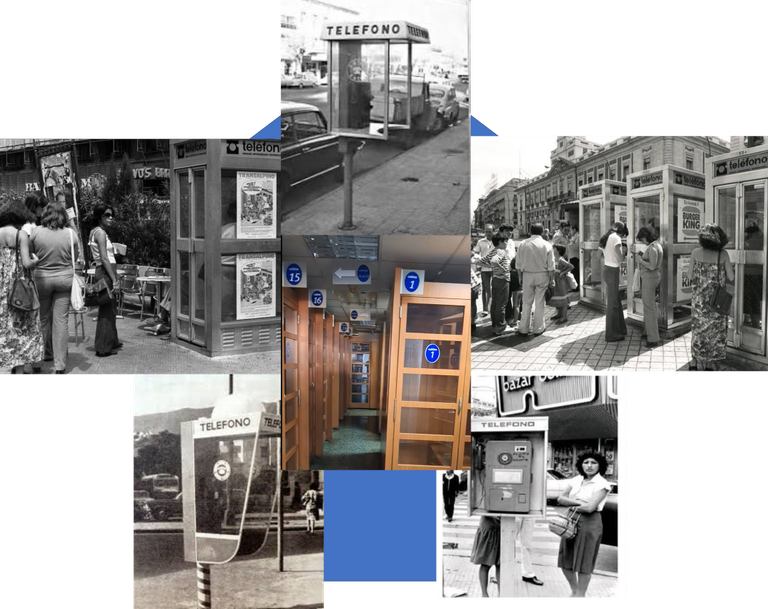
ᵃˡˡ ⁱᵐᵃᵍᵉˢ ʷᵉʳᵉ ᵗᵃᵏᵉⁿ ᶠʳᵒᵐ ᵗʰᵉ ʷᵉᵇ ᵃⁿᵈ ᵗⁱˡᵉᵈ ᵗᵒᵍᵉᵗʰᵉʳ ᵘˢⁱⁿᵍ ᴾᵒʷᵉʳᴾᵒⁱⁿᵗ ³⁶⁵ ᴾʳᵒˑ
By the late 1980s and early 1990s, the privatisation of CANTV brought prepaid phone cards. Those collectable-design cards replaced the weight of coins in our pockets. Soon after, during a period of economic and technological opening, new players entered the scene. We no longer saw just the blue and white of the state telecom. Suddenly, Movistar’s yellow and blue (inheriting Telcel’s infrastructure), Movilnet’s vibrant red, and Digitel’s green began populating our pavements with modern phone boxes, some featuring digital screens that seemed plucked from the future.
As an adult, I remember the rise of “private phone booths” in shopping centres. These were small rooms where an operator would assign you a booth number, you’d step inside, close the glass door, and enjoy the privacy the street noise denied you. It was a ritual of waiting for the operator’s signal to confirm how much time you’d used and what you owed.
Yet the clock of technology never stops. With the turn of the millennium and the internet boom, these boxes underwent a metamorphosis. Many ceased to be voice-only hubs and became cyber cafés or quick-navigation centres. The clatter of dialling buttons gave way to the click of a mouse. It was the beginning of the end.
In my memory, I walk the same streets of my youth and see the rusted frames of what were once meeting points. The contrast is striking: from queuing in the sun to use a CANTV phone box, we’ve moved to carrying the entire world in the palm of our hand. The mobile phone is no longer just a tool, as it once was; today, it is quite literally an extension of our bodies. The modern pedestrian walks hunched over their screen, forgetting that we once had to step out into the street just to “connect” with someone.
For us Silver Bloggers, these phone boxes are monuments to patience and the human voice. Though I now appreciate the immediacy of my smartphone for keeping in touch with family in Venezuela from Canada, I sometimes miss the quiet mystery of stepping into a booth, dialling a number from memory, and waiting, heart pounding, for someone on the other end to lift the receiver and say: “Hello!”
Hi! Everybody (friends), if you've made it this far, THANK YOU! You are welcome to participate; the link with all the information is below. But I also hope to read your comments in the reply box. Thank you for joining us in these waters of HIVE.
The Silver Bloggers Chronicles #47

Cover of the initiative.

Dedicated to all those writers who contribute, day by day, to making our planet a better world.

