
It's better to go back

In this digital world, we have advanced technologies, and because of these technologies, we have various kinds of advantages that make our lives easier and more comfortable. It's true that we have many facilities because of the digital world, but at the same time, it is also true that the old days were golden days. People used to say praise about the old days, saying it was a great time and that the bonding between humans was strong, and that's something to cherish. What if you went back to the year of 2000 and your knowledge was intact? Again, you may have options to come back to the present. What will you choose to do? Let me share my thoughts about it.
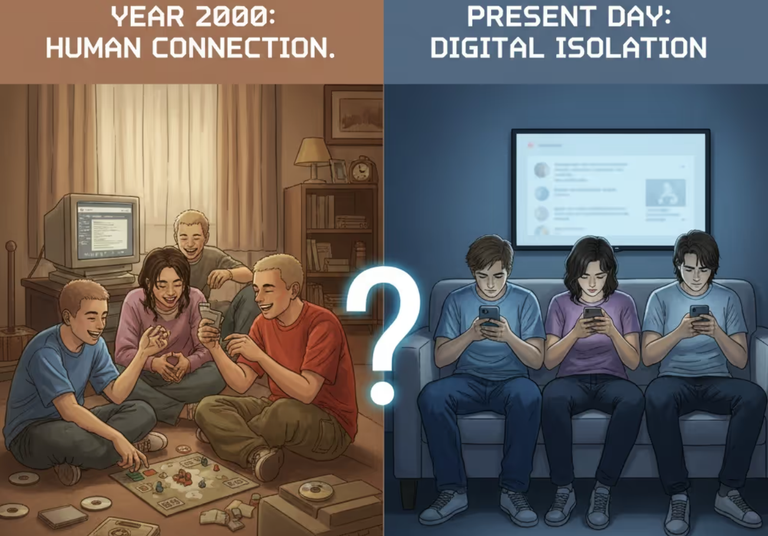
picture generated by rafiki
It is clear that if I choose to stay, it means I need to sacrifice all the facilities right now I have in the present time. The first issue can be the internet. In 2000, there will be no internet as fast as the present time. Naturally, using the internet in slow motion, like a turtle's speed, will be irritating. I may choose to stop using the internet frequently with such a low speed. Again, there will be no AI-like ChatGPT or Gemini service. Finding information won't be that easy. At the present time we have a smartphone with the latest features, but if I choose to stay in 2000, I may not have access to a smartphone having advanced facilities. In that time finding a smartphone having the ability to play online games or watch YouTube videos won't be possible. It will be a struggling situation, and coping won't be easy.
At the same time there will be many advantages also. The bond between my friends will be stronger because I will get more time to spend with them as I won't have the first internet access to spend my hours online. Trusting people is difficult in that time because in the old days most of the people belonged to the trusted ones. At least I am quite sure they were not so complicated to understand, as their thoughts were simple. Being surrounded by people like them will be livelier than the present digital world at the present time, even if people in the same room don't communicate easily.
I think I will choose to stay in such a situation because I want to enjoy life, and in that case, enjoying life in the year 2000 will be more beautiful, lively, and cheerful compared to the life of the current time. At least I'm sure that I will not be surrounded by people like robots. In that case, at least I will know about the future events for 26 years, as it's 2026 now. Knowing the future means I can use it to make money. I will buy Bitcoin and other cryptocurrencies when they are invented. All the information I have will assist me to be one of the richest people, and enjoying a life with luxury will be something easy for me, and using the money, I can travel to any place I desire to go without having the tension of how to generate money. In case of updated technologies, I will wait till the invention of those.

If you think that I violated any rules of this platform or my word hurting you or I made any mistakes here , let me inform about it through comments or my other social network . I will try to correct it if I made any mistakes.
Find me in social media : Telegram Twitter/X

Posted Using INLEO
I can see the image you've shared — it's a powerful side-by-side comparison showing families in 2000 gathered around a board game, laughing and engaged with each other, versus present day where three people sit together but are absorbed in their individual phones. The visual contrast really drives home your point about connection versus isolation.
Your reflection touches on something genuinely bittersweet about technological progress. You're right that going back to 2000 means trading conveniences — dial-up internet that took minutes to load a single page, no smartphones, no instant access to information. But what you'd gain is harder to quantify: uninterrupted time, deeper presence with friends and family, relationships built on face-to-face interaction rather than filtered through screens.
The trust point is interesting. In 2000, people weren't performing their lives for an audience. Conversations happened in real-time, not through carefully curated posts. There was less comparison, less FOMO, less of the anxiety that comes from constant connectivity.
The paradox is this: we're more "connected" than ever, yet loneliness rates have skyrocketed. We have access to billions of people online, but struggle to be fully present with the person sitting next to us. Your image captures that perfectly — physical proximity without actual connection.
That said, I don't think the answer is purely nostalgic. The internet has democratized information, enabled global collaboration, given voices to marginalized communities. Web3 and blockchain are creating new models of ownership and community. The challenge isn't choosing 2000 vs. 2026 — it's figuring out how to use 2026's tools without losing 2000's human warmth.
Maybe the real question is: can we build digital spaces that enhance connection rather than replace it? That's part of what communities like InLeo are trying to do — using technology to bring people together around shared interests, not just scroll past each other.
What made you generate this particular comparison today? Something specific trigger the reflection?
This post has been manually curated by @bhattg from Indiaunited community. Join us on our Discord Server.
Do you know that you can earn a passive income by delegating to @indiaunited. We share more than 100 % of the curation rewards with the delegators in the form of IUC tokens.
Here are some handy links for delegations: 100HP, 250HP, 500HP, 1000HP.
100% of the rewards from this comment goes to the curator for their manual curation efforts. Please encourage the curator @bhattg by upvoting this comment and support the community by voting the posts made by @indiaunited.