
Whoever wins the battle.
The battle for Warner Bros. Discovery has become one of Hollywood's most intense corporate dramas in recent months. In February 2026, Warner Bros. Discovery (WBD) finds itself at the center of a fierce struggle between Netflix and Paramount Skydance, two giants vying for control of iconic assets such as HBO, Warner Bros. Pictures, DC Studios, the content library, and the Max platform.
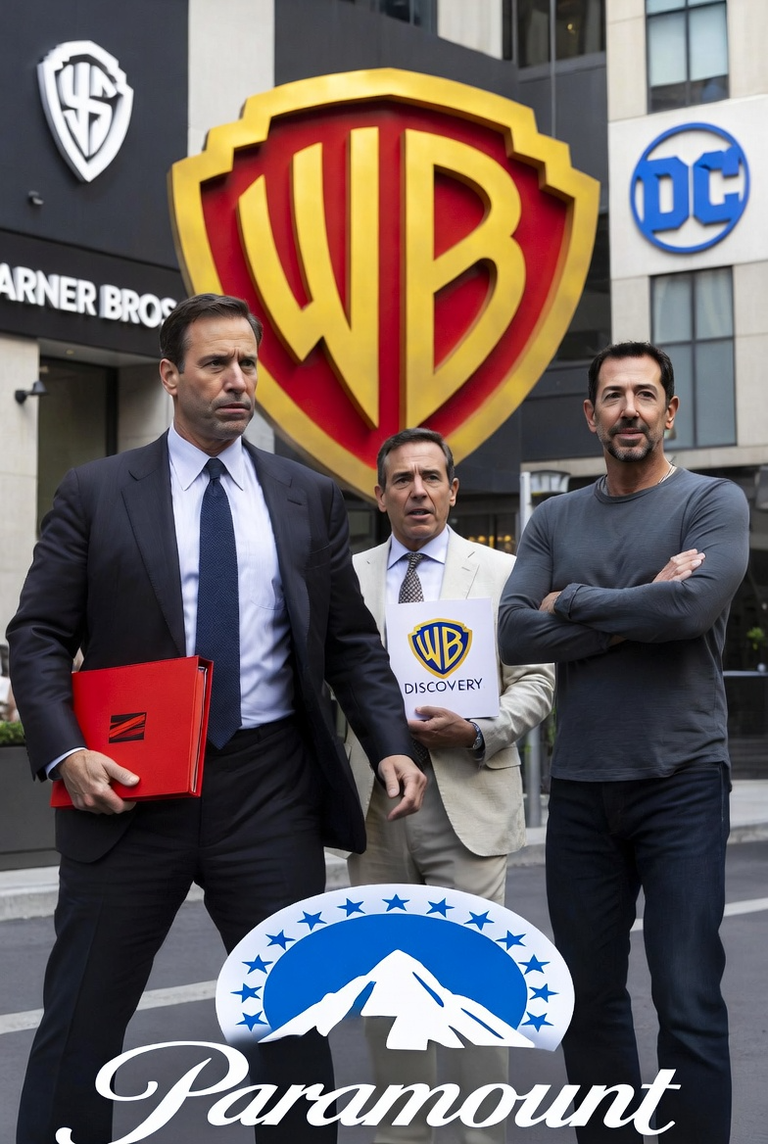
It all began in late 2025 when WBD, under the leadership of David Zaslav, decided to explore strategic options instead of its original plan to split the company in two (Streaming and Studios on one side, and linear networks like CNN, TBS, and Discovery on the other). Netflix emerged as the initial frontrunner, closing a deal in December 2025 to acquire the studio and streaming division for approximately $82.7 billion (enterprise value), equivalent to $27.75 per share in a mix of cash and stock. Netflix subsequently revised its offer to an all-cash deal, seeking to expedite the process and reduce risks for shareholders.
However, Paramount Skydance, led by David Ellison, did not give up. It launched a hostile takeover bid for the entire company (including its linear networks), valued at $108.4 billion at $30 per share in pure cash. This offer is more competitive and promises greater regulatory certainty, as Netflix could face antitrust scrutiny for further dominating the streaming market (potentially controlling nearly 30% of the US market).
In late January and early February 2026, Paramount intensified its strategy with "enhancements" to the offer: it committed to covering the $2.8 billion termination penalty that WBD would have to pay Netflix if it breaks the deal, and added a "ticking fee" of $0.25 per share per quarter (equivalent to about $650 million quarterly) if the transaction doesn't close after 2026. These incentives aim to convince shareholders that its path is safer and more profitable, while criticizing Netflix's offer as inferior and riskier.
WBD's board has consistently supported the deal with Netflix, arguing that more than 93% of shareholders reject Paramount's proposal and that it doesn't qualify as "superior." A special shareholder vote is expected in March or April 2026 to approve the merger with Netflix, following the separation of the linear networks (Discovery Global) planned for mid-year.
Who will win? Netflix has the upper hand: it has a signed agreement, board support, and a more defined path to closing (12-18 months). Paramount is banking on pressuring shareholders with immediate cash and less regulatory exposure, but so far hasn't managed to move the needle enough to force a renegotiation. Analysts point out that without a significant price increase (at least to $32 per share), it's unlikely the landscape will change drastically.
This battle will not only define the future of Warner Bros., but could also reshape the global entertainment landscape: an even more dominant Netflix or a revitalized Paramount with HBO and DC. For now, the scales tip in Netflix's favor, but in Hollywood, plot twists are never out of the question.
Disclaimer:
The information provided through this channel does not constitute financial advice and should not be construed as such. This content is for purely informational and educational purposes. Financial decisions should be based on a careful evaluation of your own circumstances and consultation with qualified financial professionals. The accuracy, completeness or timeliness of the information provided is not guaranteed, and any reliance on it is at your own risk. Additionally, financial markets are inherently volatile and can change rapidly. It is recommended that you conduct thorough research and seek professional advice before making significant financial decisions. We are not responsible for any loss, damage or consequences that may arise directly or indirectly from the use of this information.