
Times change, and so do glories [EN/PT]

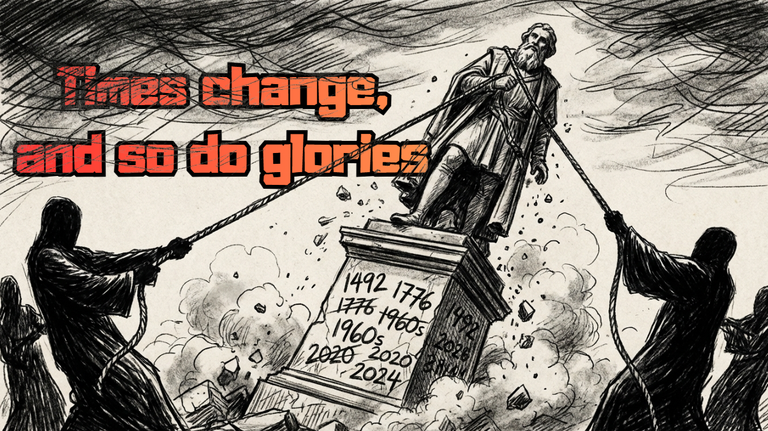
Perhaps the pinnacle of a person's life is to truly make a difference in human history with great achievements. A tribute, something to be immortalized as a great monument, mentions in books, statues. This is for the few, only for those who have truly had a great significance in history. Not everyone is remembered as a great hero, but monuments are usually erected for heroes, until... well, we realize that these achievements were not exactly what they should have been or that, in a way, that person was not really a hero after all. But when something outside the scope of “hero” is discovered, should honorable mentions be removed, monuments torn down, and adjustments made to history books?
Some great names in history will always be remembered for their deeds, and before writing about this, I did a brief research on Christopher Columbus, the great navigator. I had already heard some comments about people's new perception of his achievements. For those who don't know, Christopher Columbus was a navigator who sailed in the service of the Spanish Crown and arrived in the Americas around 1500. Of course, he is mentioned in virtually every book for his role in the Great Navigations. I myself learned about this and, until then, saw nothing wrong with this recognition, despite the controversies that have always existed, but that is a subject for another time. The big issue here is the honor, the pedestal created around his achievement of reaching the Americas.
I have already talked about this in a previous post, that in my view, discovering something that already has other people living there is somewhat controversial if we compare it to the real meaning of the word discover. But the point is that, after so many years, especially since 2020, “several statues of Columbus have been toppled by protesters or removed by local authorities and, in some cases, replaced by indigenous memorials.” In many places, Columbus Day has been replaced by Indigenous Peoples' Day. Just by observing this, it is possible to see that, despite his great nautical achievement, Columbus is not so well regarded, especially in places directly affected by colonization.
Of course, at that time it meant a lot. It was a new horizon, but a new horizon seen from Europe and also an opportunity for exploration. For those who explore, it may sound grand, but what about those who are explored? With the passage of time and greater historical awareness, many people began to see not only the arrival in the Americas, but also the consequences of it. It is not just about the journey itself, but the way indigenous peoples were treated, exploited, had their lands taken, and their cultures destroyed. It is clear that there were profound impacts from this historical milestone. Perhaps, at that time, this was seen as part of the natural order of things, the strong dominating the weak. Still, that does not mean there should be statues, holidays, and unrestricted celebrations in the name of a symbol that also represents exploitation and violence, especially in the places where it all happened.
On the one hand, Columbus can be seen as the explorer who paved the way for the formation of the modern world, for those who like to see things that way. But on the other hand, he is also a symbol of colonialism, violence, and indigenous oppression. I believe that if something comes to represent an event that is viewed negatively by the majority, it should indeed be less exalted or even annulled as something grandiose. Let it be recorded in history, if necessary, but there are limits between recognizing a historical fact and glorifying it. Times change, and so do glories.
Credits:
Translated: Deepl
Cover: created by Canva.
AI-generated image Flow

Talvez o ápice de uma pessoa seja realmente fazer a diferença na história da humanidade com grandes feitos. Uma homenagem, algo a ser eternizado como um grande monumento, menções em livros, estátuas. Isso é para poucos, apenas para aqueles que realmente tiveram uma grande significância na história. Nem todos são lembrados como grandes heróis, mas monumentos costumam ser erguidos para heróis, até que... bem, percebemos que esses feitos não eram exatamente aquilo que deveriam ser ou que, de certa forma, essa pessoa não era tão precisamente um herói assim. Mas quando algo fora do escopo de “herói” é descoberto, menções honrosas devem ser retiradas, monumentos derrubados e ajustes nos livros de história devem ser feitos?
Alguns grandes nomes da história sempre serão lembrados por seus feitos e, antes de escrever sobre isso, eu dei uma breve pesquisada sobre Cristóvão Colombo, o grande navegador. Eu já tinha ouvido alguns comentários sobre a nova concepção das pessoas em relação aos seus feitos. Para quem não sabe, Cristóvão Colombo era um navegador que navegou a serviço da Coroa espanhola e chegou às Américas por volta de 1500. Claro, ele é citado em praticamente todos os livros por seu papel nas Grandes Navegações. Eu mesmo aprendi sobre isso e, até então, não via nada de errado nesse reconhecimento, apesar das controvérsias que sempre existiram, mas isso é assunto para outra hora. A grande questão aqui é a honraria, o pedestal criado em torno do seu feito de ter chegado às Américas.
Eu já falei sobre isso em um post anterior, que dentro da minha concepção descobrir algo que já possui outras pessoas vivendo ali é algo um pouco controverso se compararmos com o real significado da palavra descobrir. Mas a questão é que, depois de tantos anos, especialmente a partir de 2020, "várias estátuas de Colombo foram derrubadas por manifestantes ou removidas por decisão de autoridades locais e, em alguns casos, substituídas por memoriais indígenas". Em diversos lugares, o Dia de Colombo foi substituído pelo Dia dos Povos Indígenas. Só de observar isso já é possível perceber que, apesar do grande feito náutico, Colombo não é tão bem visto assim, principalmente nos locais diretamente afetados pela colonização.
Claro, para aquela época isso significava muito. Era um novo horizonte, mas um novo horizonte visto da Europa e também uma oportunidade de exploração. Para quem explora pode soar grandioso, mas e para quem é explorado? Com o passar do tempo e com maior conscientização histórica, muitas pessoas passaram a enxergar não apenas a chegada às Américas, mas as consequências disso. Não se trata apenas da viagem em si, mas da forma como os povos indígenas foram tratados, explorados, tiveram suas terras tomadas e culturas destruídas. É evidente que houve impactos profundos a partir desse marco histórico. Talvez, para aquela época, isso fosse visto como parte da ordem natural das coisas, o mais forte dominando o mais fraco. Ainda assim, isso não significa que devam existir estátuas, feriados e celebrações irrestritas em nome de um símbolo que também representa exploração e violência, especialmente nos lugares onde tudo aconteceu.
De um lado, Colombo pode ser visto como o explorador que abriu caminho para a formação do mundo moderno, apara aqueles que gostam de ver as coisas assim. Mas de outro, é também um símbolo do colonialismo, da violência e da opressão indígena. Eu acredito que, se algo passa a representar majoritariamente um acontecimento visto de forma negativa, ele deve, sim, ser menos exaltado ou mesmo anulado como algo grandioso. Que fique registrado na história, se for o caso, mas existem limites entre reconhecer um fato histórico e glorificá-lo. Os tempos mudam e as glórias também.
Credits:
Translated: Deepl
Cover: created by Canva.
AI-generated image Flow
Just like the name you mentioned, Colombus, I am sure that history only wrote his good side first before people later researched about what he really did. And that is how history should be. Proper and full story, not one sided story to fool the people around
I wouldn’t be surprised if his achievement was actually used for political advantage at that time
History today doesn’t really tell us both sides of the story. I believe this is why people take action when they find out the hidden parts of our history
Yes, there’s a lot involved and a lot they want us to know....