
Does the law have two weights? [EN/PT]

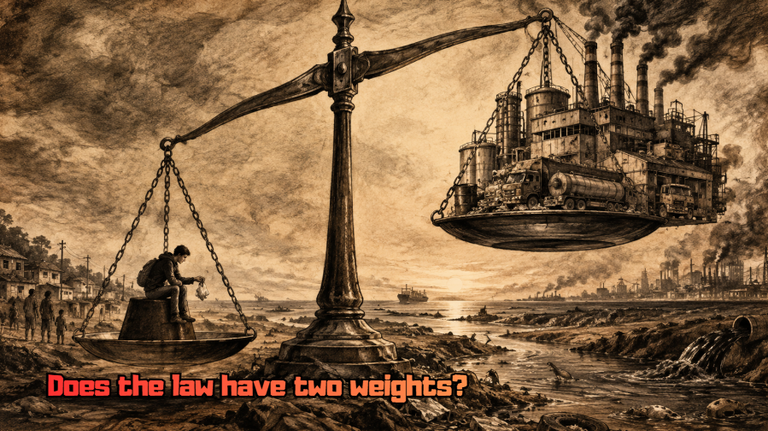
We can say that we live in a society where there are rules for practically everything. From simple things, such as not throwing garbage on the street, to much more complex issues involving companies, the environment, and large amounts of money. When a person throws a bottle, a bag, or any other type of garbage on the street, they can be fined and even face legal consequences for it, depending on the situation. And, in a way, that makes sense, after all, each of us needs to be responsible for our own actions. But then an important question comes to mind: does this same logic really apply when we are talking about large companies? A person can be held responsible for throwing a small amount of garbage on the street, while a company can cause a huge environmental impact, affecting rivers, seas, roads, animals, and thousands of people. This is where I start to wonder whether we are really talking about justice or simply a difference in the size of those who make the mistake.
I don't mean to say that all companies are irresponsible or that the government simply ignores the problems they cause. There are laws, fines, inspections, and legal proceedings that can be applied when a company causes environmental damage. The problem is that, many times, when we look at the scale of the damage caused and compare it with the consequences faced, there seems to be a huge difference. A person can receive a fine that weighs heavily on their own pocket for a small action, while a company can face a million-dollar fine that, depending on its size, ends up being just another cost within its operations. And when we talk about environmental damage, there is something even more complicated: not everything can be recovered with money. A contaminated river, a destroyed area, or dead animals do not simply come back because a company paid a fine. Money can compensate for part of the losses, but it does not necessarily erase what happened.
I have personally noticed how small actions can make a difference when I see the amount of garbage accumulated in some places after a weekend or an event. Sometimes you pass by a place that was clean and, a few days later, you find bottles, packaging, and other things scattered around. It is easy to look at that and think that the problem is only with the person who threw the garbage there, but we also need to think about those who produce, transport, dispose of, and profit from all of it. Responsibility should not disappear simply because the problem has become bigger or because companies are involved. In fact, the greater the power to cause an impact, the greater the responsibility for the consequences should also be.
Perhaps the issue is not simply about being tougher on companies or more lenient with individuals, but about finding a model where responsibility is proportional to the damage caused. A person who throws a piece of paper on the ground and a company that contaminates an entire region cannot receive exactly the same treatment, but there also should not be a situation where money or the size of a company serves as a kind of protection. If a rule exists to protect society, it should apply to everyone. After all, there is little point in teaching a child not to throw garbage on the ground while allowing much larger problems to be treated merely as numbers on a spreadsheet. In the end, I believe that a truly fair society should not ask who caused the problem, but rather what damage was caused and who needs to be held responsible for it.
Credits:
Translated: Deepl
Cover: created by Canva.
AI-generated image Flow

Podemos dizer que vivemos em uma sociedade onde existem regras para praticamente tudo. Desde coisas simples, como não jogar lixo na rua, até questões muito mais complexas que envolvem empresas, meio ambiente e grandes quantidades de dinheiro. Quando uma pessoa joga uma garrafa, uma sacola ou qualquer outro tipo de lixo na rua, ela pode ser multada e até responder legalmente por isso, dependendo da situação. E, de certa forma, isso faz sentido, afinal, cada um de nós precisa ser responsável pelas próprias atitudes. Mas então surge uma pergunta que considero bastante importante: será que essa mesma lógica realmente funciona quando estamos falando de grandes empresas? Uma pessoa pode ser responsabilizada por jogar uma pequena quantidade de lixo na rua, enquanto uma empresa pode causar um impacto ambiental gigantesco, afetando rios, mares, estradas, animais e milhares de pessoas. É nesse ponto que começo a questionar se estamos realmente falando de justiça ou apenas de uma diferença de tamanho entre quem comete o erro.
Não quero dizer que todas as empresas sejam irresponsáveis ou que o governo simplesmente ignore os problemas causados por elas. Existem leis, multas, fiscalizações e processos que podem ser aplicados quando uma empresa causa danos ambientais. O problema é que, muitas vezes, quando observamos a proporção do dano causado e comparamos com as consequências sofridas, parece existir uma enorme diferença. Uma pessoa pode receber uma multa que pesa bastante no próprio bolso por uma atitude pequena, enquanto uma empresa pode enfrentar uma multa milionária que, dependendo do seu tamanho, acaba sendo apenas mais um custo dentro de suas operações. E quando falamos de danos ambientais, existe ainda algo muito mais complicado: nem tudo pode ser recuperado com dinheiro. Um rio contaminado, uma área destruída ou animais mortos não voltam simplesmente porque uma empresa pagou uma multa. O dinheiro pode compensar parte dos prejuízos, mas não apaga necessariamente aquilo que aconteceu.
Eu mesmo já percebi como pequenas atitudes podem fazer diferença quando observo a quantidade de lixo acumulado em alguns lugares depois de um fim de semana ou de algum evento. Às vezes você passa por um local que estava limpo e, poucos dias depois, encontra garrafas, embalagens e outros coisas espalhadas. É fácil olhar para aquilo e pensar que o problema é apenas de quem jogou o lixo ali, mas também precisamos pensar em quem produz, transporta, descarta e lucra com tudo aquilo. A responsabilidade não deveria desaparecer simplesmente porque o problema ficou maior ou porque existem empresas envolvidas. Na verdade, quanto maior o poder de causar um impacto, maior deveria ser também a responsabilidade sobre as consequências.
Talvez a questão não seja simplesmente ser mais duro com empresas ou mais leniente com indivíduos, mas encontrar um modelo onde a responsabilidade seja proporcional ao dano causado. Uma pessoa que joga um papel no chão e uma empresa que contamina uma região inteira não podem receber exatamente o mesmo tratamento, mas também não deveria existir uma situação em que o dinheiro ou o tamanho da empresa sirvam como uma espécie de proteção. Se uma regra existe para proteger a sociedade, ela deveria funcionar para todos. Afinal, de pouco adianta ensinar uma criança a não jogar lixo no chão enquanto permitimos que problemas muito maiores sejam tratados apenas como números em uma planilha. No fim, acredito que uma sociedade realmente justa não deveria perguntar quem causou o problema, mas principalmente qual foi o dano causado e quem precisa responder por ele.
Credits:
Translated: Deepl
Cover: created by Canva.
AI-generated image Flow
Congratulations @michupa! You have completed the following achievement on the Hive blockchain And have been rewarded with New badge(s)
Your next payout target is 58000 HP.
The unit is Hive Power equivalent because post and comment rewards can be split into HP and HBD
You can view your badges on your board and compare yourself to others in the Ranking
If you no longer want to receive notifications, reply to this comment with the word
STOPCheck out our last posts: