
27-10-2026 - Wen Wang Gua reading for an Old Colleague

by @bardsilver on Brave-Smoke's Corner
View my bio on Blurt.media: https://blurt.media/c/bravesmoke 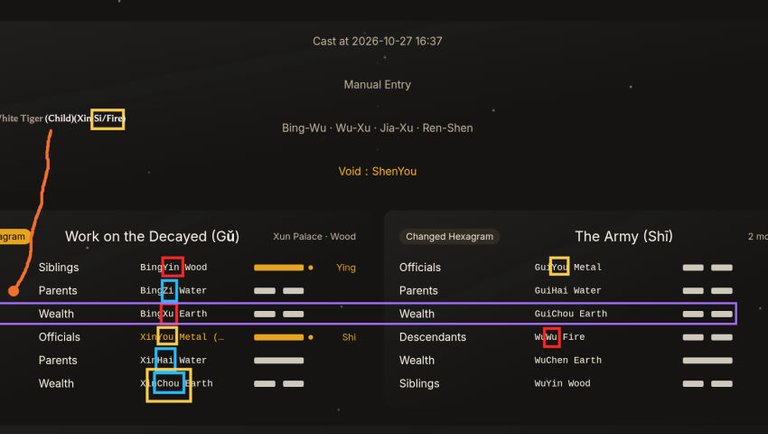
The I Ching gives a hexagram and a short classical judgement. That is enough for a reader who wants to sit with a text, and not always enough for a practitioner who has been asked a specific question with a specific stake. Wen Wang Gua (文王卦) is the method that fills the gap: it uses the same sixty-four hexagrams but attaches a stem, a branch and an element to every line, and then reads the figure the way a BaZi chart is read — by relation and by strength, not by commentary.
The method is also called Liu Yao (六爻), "six lines", and the technical name for its apparatus is najia (納甲), the "receiving of stems". It is the working divination of the Chinese tradition: the form most often used when the question requires concrete, precise answers.
Both approaches begin with the same cast, made the same way. Then they part. A textual reading asks what the hexagram as a whole, and any changing lines, say about the situation; it leans on the received judgements and the commentarial tradition. Wen Wang Gua ignores the written judgement almost entirely and reads the figure as a structure: which element sits on which line, how those elements relate to the palace the hexagram belongs to, which line carries the subject of the question, and which lines are moving.
The method expects the practitioner to have three things in hand: the stems, the branches and their elements; the assignment of the sixty-four hexagrams to the eight palaces; and the naming of the relations between elements. All three are shared with other systems — the stems with BaZi and the calendar, the elements with the Five Elements that underlie the whole tradition. Wen Wang Gua does not invent a new alphabet; it applies the existing one to a question.
Compared to the traditional discipline, the Yi/Iching's judgements are full of advice about conduct; Wen Wang Gua uses them as labels and reads structure instead, which is why it can be learned and applied without any interest in the philosophy of the book. It is also not a replacement for the Yi; the text and its commentarial tradition stand on their own, though one may find much use in cross referencing the original bronze age text.
Wen Wang Gua is formless and breaks all rules, requiring a lateral mind rather than linear thinking. Because it is formless and because it is not limited in it's expression by rules and framework (as compared to the use of the Bronze Age Text-matrix), it is very difficult to master. Yet it can be mastered with an open, supple, nimble, formless mind.
Nor is it a different art from BaZi. The two share the stems, the branches and the elements, and a practitioner who reads charts will recognise the vocabulary at once; the difference is what is being read — a life from birth data, against a question from a cast. If you want the chart side, the BaZi section is the place to start.