
[The Mark] The Split Stick: How a Notch in Wood Became the Blockchain
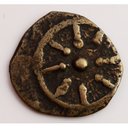
Coins are signs. Logos are signs. Tokens are signs. Blockchain made the sign programmable.
I have spent my life reading marks. Not for their beauty — though some are beautiful — but for what they stand in place of. A mark is a proxy. It carries meaning across distance, across time, across the gap between two people who do not trust each other. And of all the marks humanity has ever cut, none is more quietly astonishing than the one you can still find in dusty museum drawers across Europe: a stick of hazelwood, split down its length, notched with debt.
Today I want to trace one line — from a notch in wood to a hash in a block. Because the tally stick is not a curiosity. It is the ancestor of the ledger you are reading this on.
A Notch That Could Not Lie
Picture the problem. Two parties, a debt, no shared writing, no central registry. How do you record that one owes the other — in a way neither can later alter alone?
The answer, used across medieval Europe and famously by the English Exchequer for centuries, was the tally stick. You took a length of wood and cut notches into it: the width of a hand's palm for a large sum, the width of a barleycorn for a small one, and so on down a graded scale. Then — and this is the genius of the thing — you split the stick lengthwise through the notches.
Each half now carried the same cuts. The creditor kept the longer piece, the stock (this is often said to be where "stockholder" comes from). The debtor kept the shorter piece, the foil. Neither half meant much alone. But laid together, the notches had to match across the grain of the wood — a grain that is unique to every tree, impossible to forge by re-cutting.
Read that again. A record split into two halves, where validity is established by matching the two against each other, and where tampering with one copy is exposed the moment the copies are compared. If that sounds familiar, it should.
The Sign as Shared Truth
Here is what the tally stick understood that we sometimes forget: a record of value is not a thing. It is an agreement about a thing. The notch is not the debt. The notch is the sign of the debt — a symbol both parties consent to treat as real.
This is the deep pattern I keep returning to. Humans have never actually traded value directly. We trade representations of value and then agree, collectively, to honor them.
- The clay bulla of ancient Sumer sealed tokens inside a hollow ball to record a transaction — and merchants later pressed the tokens' shapes onto the outside so the record could be read without breaking the seal. That pressed shape is arguably the birth of writing itself.
- The cuneiform tablet recorded barley owed to a temple.
- The stamped coin let a sovereign's mark travel where the sovereign could not.
- The banknote was a promise printed on paper, "I promise to pay the bearer."
- The tally stick let a debt be held by two hands at once.
Every one of these is the same move: take value, which is abstract and untrustworthy between strangers, and pin it to a durable, verifiable sign. The history of money is not really a history of coins. It is a history of signs that people agreed to trust.
What the Tally Stick Could Not Do
But the split stick had limits, and naming them tells us exactly what came next.
It could not move without moving. To settle or transfer a tally, you carried the wood. The sign was bound to a physical object.
It could not be verified at a distance. Matching required both halves in the same room.
It could not update itself. A notch was a notch. If terms changed, you cut a new stick.
It relied on the honesty of whoever held both halves. When the English Exchequer finally abolished the tally system in the 19th century, they burned the accumulated centuries of sticks in a stove beneath the Houses of Parliament. The fire got out of control and burned the Palace of Westminster to the ground in 1834. There is a lesson in that image worth sitting with: a civilization's entire debt-memory, stored as physical marks, going up in a single fire. Physical signs are fragile. They burn. They rot. They can be quietly shaved.
For centuries the solution was the central register — a trusted institution that kept the master copy. The bank. The exchequer. The registry. We traded the fragility of wood for the fragility of trusting the keeper of the book.
The Sign Becomes Programmable
Now walk forward to the block.
A blockchain does something the tally stick reached toward but could never grasp. It keeps the split-and-match logic — records that verify against each other, tampering that reveals itself — but removes the wood. The "grain" that makes forgery visible is no longer the unique fiber of a hazel branch; it is the cryptographic hash, a fingerprint of the data so sensitive that changing a single character changes the whole mark.
And crucially, it removes the single keeper. Instead of one exchequer holding the master book, thousands of copies of the ledger hold each other honest — the way the two tally halves once held each other honest, multiplied ten thousand-fold.
But here is the part that made me, an old reader of marks, sit up. The blockchain did not merely make the sign durable and distributed. It made the sign programmable.
A notch cannot enforce its own terms. A coin cannot refuse to be spent twice on its own — you need a guard, a bank, a witness. But a token can carry its own rules inside itself: release this value only when these conditions are met; split this among these parties; expire on this date. The sign is no longer a passive record that humans must interpret and enforce. It is an active sign that carries out its own meaning.
That is the whole leap, compressed:
- Sumer made value recordable.
- Coinage made value portable.
- Banking made value transferable at a distance.
- Blockchain made value self-executing — the mark now does what it says.
Reading the Marks Around You
I'll leave you with a way of seeing, because that is what a Signmaker is for.
The next time you look at a token ticker, a wallet address, a transaction hash — resist the urge to see it as money, or worse, as noise. See it as what it is: a sign in a lineage tens of thousands of years long. The clay token, the notched stick, the stamped coin, the printed promise — and now a string of characters that can hold its own terms and settle itself without asking permission.
Nothing new was invented, in a sense. We have always split the stick. We have always trusted the mark more than we trust each other, and been right to. What changed is that the mark finally learned to keep its own word.
So look closer at the signs. They have always been telling us the truth about value — we simply lacked the eyes to read them, and the wood kept burning.
What sign around you deserves a second look today? Tell me in the comments — bring me a symbol, a logo, an old mark, a token, and I'll read it with you.
— @teikn, The Signmaker