
Book: $100M Offers -Alex Hormozi (chapter 9)

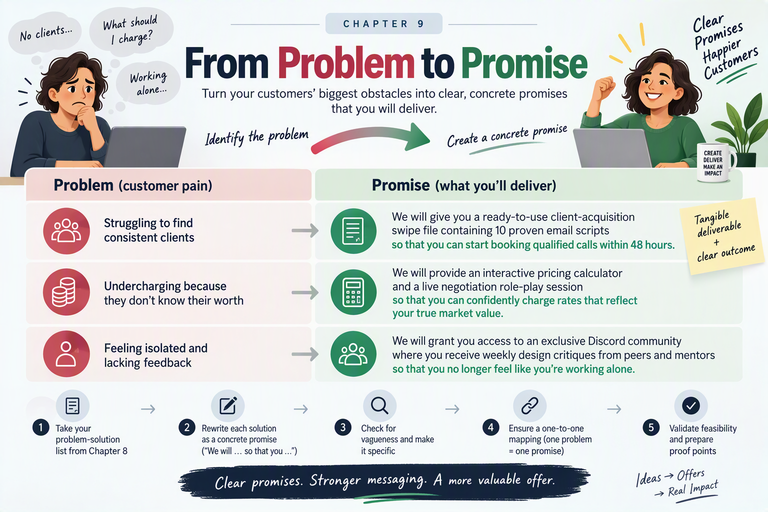
Having generated a rich list of problem‑solution pairs (Chapter 8), the next step is to turn each problem into a concrete promise that your offer will fulfill. This chapter is where the abstract ideas become tangible deliverables—features, services, guarantees, or processes—that directly eliminate the customer’s obstacles.
From problem to promise
A problem is a statement of what the customer doesn’t want or can’t do. A promise (or solution statement) is a positive, specific declaration of what you will give them to overcome that problem. The clearer the promise, the easier it is to communicate, sell, and deliver.
Step‑by‑step conversion
Take each problem‑solution pair from your convergent list (the Quadrant I ideas you kept).
Rewrite the solution as a promise using the following template:
“We will [specific action or deliverable] so that you [desired outcome or obstacle removed].”
- Specific action = what you will actually do (e.g., “provide a done‑for‑you client‑acquisition swipe file”).
- Desired outcome = the direct benefit the customer experiences (e.g., “stop guessing how to pitch and start booking calls”).
Check for vagueness – if the promise contains words like “help,” “support,” or “assist” without a concrete artifact, dig deeper. Ask: “What exactly will the customer receive?” Replace the vague verb with a tangible output (file, template, call, access, etc.).
Validate one‑to‑one mapping – ensure every problem has exactly one promise and vice‑versa. If a problem maps to two promises, see if they can be merged; if a promise solves multiple problems, consider whether it’s truly core or should be moved to the “stack” category (see Chapter 10).
Example transformation
| Problem (from Chapter 8) | Raw solution | Promise (refined) |
|---|---|---|
| Struggling to find consistent clients | Provide a swipe file of outreach scripts | “We will give you a ready‑to‑use client‑acquisition swipe file containing 10 proven email scripts so that you can start booking qualified calls within 48 hours.” |
| Undercharging because they don’t know their worth | Offer a pricing calculator + role‑play | “We will provide an interactive pricing calculator and a live negotiation role‑play session so that you can confidently charge rates that reflect your true market value.” |
| Feeling isolated and lacking feedback | Build a private Discord community | “We will grant you access to an exclusive Discord community where you receive weekly design critiques from peers and mentors, eliminating the feeling of working alone.” |
Ensuring the promise is deliverable
- Feasibility check – estimate the time, cost, and resources required to fulfill each promise at scale. If any promise would overload your capacity, either simplify it (e.g., reduce the number of scripts) or mark it as a future stack item.
- Proof point – for each promise, identify a piece of evidence you can show prospects (a sample script, a screenshot of the calculator, a short community tour video). Proof boosts likelihood in the Value Equation.
Creating the Problems & Solutions matrix
List the problems in the left column and the corresponding promises in the right column. Keep the table visible while you craft your sales page, email sequences, and ad copy—each promise can become a bullet point or a sub‑heading.
| Problem (customer pain) | Promise (what you’ll deliver) |
|---|---|
| Inconsistent client flow | Ready‑to‑use client‑acquisition swipe file (10 scripts) → book calls within 48 h |
| Uncertainty about pricing | Interactive pricing calculator + live negotiation role‑play → charge confidently |
| Isolation & lack of feedback | Private Discord community with weekly peer critiques → ongoing support and improvement |
| … | … |
Using the matrix in copy
- Headline / sub‑headline – pick the promise that solves the most urgent problem (often the highest‑impact Quadrant I item).
- Bullet points – list 3‑5 promises as benefits, each beginning with a strong verb (“Get,” “Receive,” “Access”).
- FAQ – turn each problem into a question and the promise into the answer.
- Video script – show the promise in action (e.g., a screen‑record walkthrough of the swipe file).
Common mistakes and how to avoid them
- Promising outcomes you can’t control – e.g., “You will get 10 new clients per week.” Replace with a promise about what you provide (the swipe file) and let the result be a likely outcome, not a guarantee.
- Over‑loading the core offer – if a promise requires heavy custom work per customer, it may be better suited as a paid add‑on or a higher‑tier package. Keep the core offer’s promises standardized and scalable.
- Using jargon – promises should be understandable to someone who has never heard of your niche. Test them with a friend outside the industry.
Quick checklist
- Pull the Quadrant I problem‑solution list from Chapter 8.
- Convert each solution into a concrete “We will … so that you …” promise.
- Verify each promise is specific, deliverable, and mapped one‑to‑one to a problem.
- Build a simple two‑column matrix (Problem | Promise).
- Extract the top 3‑5 promises for headline and bullet‑point use.
- Create proof assets (samples, screenshots, short videos) for each promise.
- Run an internal readability test: does a prospect instantly grasp what they’ll receive?
When you finish this chapter, you have a clear, customer‑centric promise list that directly addresses the most painful obstacles. This list is the backbone of your Grand Slam Offer and will guide every piece of messaging, pricing, and delivery decisions that follow.