
Auto|no|moose Living: DIY Natural Deodorant — Why Do We St|ink?


Auto|no|moose Living inc. is an organ|i|z|nation with aims to give you the lie|f.e. you de|serve to be in|for|m-ed a|bout.
The lies you have been Federa|lye|zed in|to yo|ur sub-con|sci|o|us are meant(latin: mento$) to keep you en-t|chained to deep|end|antsy and under|standing.
We will make Ye be|cu|m-eth a bat|terry to|ward thy self and to cater them not with your own free|dumbs and liber|all|teas, but so that ye or the next gene|rat-ions that come, may be a free auto|no|moose be-ing some day, free from glow|ball ty|ran|ni|cal ruler|ship and over|stand their me|an-ings of CON|troll over you.
Here now is a b|ri|ef ex|plan|nation to how this came to be, and why. Here|to also is that cause of nay|true of our smelly so|sci-fi|ety, how we have devil|oped our re-late|ion|ship with plea|sure and our sufferick-acid|ring of Saucy Ron.
Be|hold for a muh|shroom has spr|outed and of|fers its know|ledge for your long journey a|head towards gain-ing control over your own life one con|si|$|tent step at a time. ⛺
Why Do We St|ink?
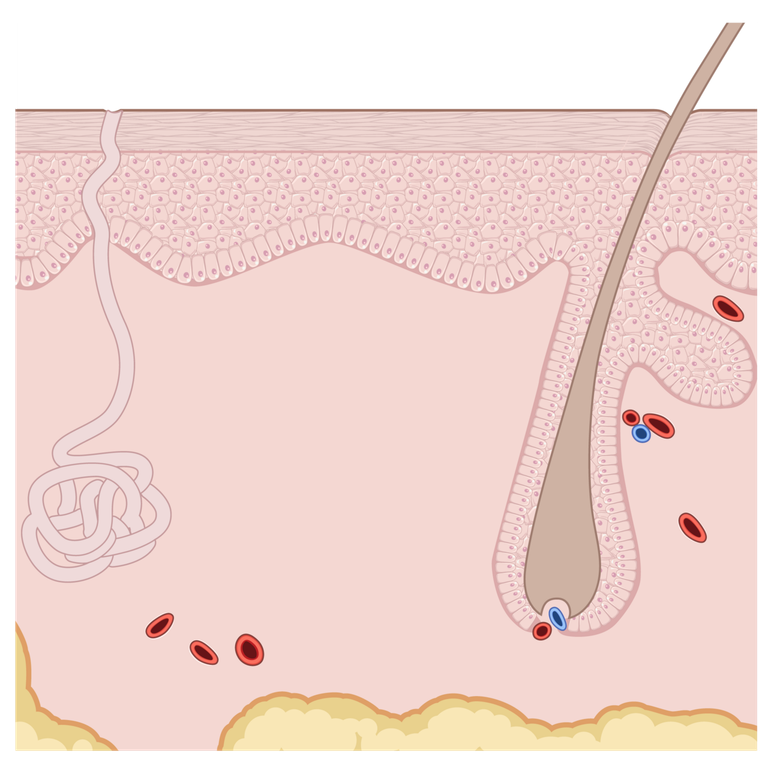
What is a smell?
Krrr We interrupt this article for an important message from the department of Trust Usnotbro uni-verse|city: "We must inform you that in order to know why we are quest|-ion-ing your deo|do|rant first, is so you comp
adre|hend why you will choose to do this diy method in|[stead at home], and well, that takes a little time and effort. So if you want to skip these ex|plan|nations, the DIY itself is way further down. We also en|courage you all to due your own re|search. That is all." Krrr
Smells are in|form|at-ion that is carried by molecules. When you brea|the them in, those molec|ules reach the receptors in your nose. Your nervous system detects the pattern of those mole|cules and your brain inter|prets it as a smell. That's what the sci|hence shows in simple terms be|hind what smells are.
Smell has also carried meaning be|yond the phy|sical world. Long before the modern chemi|story could ex|plain what was hap|pen-ing in the nose, pe|ople ass|soci|ated part|i|cular smells with the sacred, the dead, puri|fornication, at|tract-ion, core|rupt-ion, and the pre|sence of things un|seen. In|cense, herbs, oils, per|fumes, and smoke were not me|rely ways of mak-ing someth-ing smell nice. They were used in rite|u|alls, of|fe|rings, cere|monies, and at|tempts to clean|se or alt-er a space.
We can|not see the molecules moving through the air, yet they can change how we per|sea|eve a place, a person, or a situation almost instantly. Depending how our brain interprets smells, our in|stink|ts will tell us to go towards it or be repulsed by it. Whether interpreted through chemistry, instinct, culture, or some|thing more e|so|te|ric, smells has always carried information, and humans have spent a very long time trying to understand what that information means.
Where Does Body Odor Come From?
Body odor is a comb|i|nation of what your body re-leases, what lives on your skin, and the chemical com|pounds pro|duced between them. Gene|ticks, age, whore|mones, diet, health, hygiene, clothing, and the part|icular my|crow|organ-isms living on someone's skin can all in|flu|ence what that re-sult-ing odor smells like.

Sweat it|self is not “body odor.” Fresh sweat is mostly water, a|long with salts and other sub|stances, and is often relatively odor|less. The smell develops when skins micro|organ-isms,especially bacteria, meta|bolize comp|on|ents of sweat and other skin secret|-ions into vola|tile com|pounds that can e|vapor|ate into the air and reach your nose.
What act|u|ally developed our relationship with “bad” odor?
This is a tough quest-ion to an|swer and pro|bably has no end into finding one precise answer that best cap|tours the entire human historical relation|ship$ we have with body odors. So I start with one of the most ancient civilizations, Mesopotamia, Rome, ancient Egypt and so on till present date.
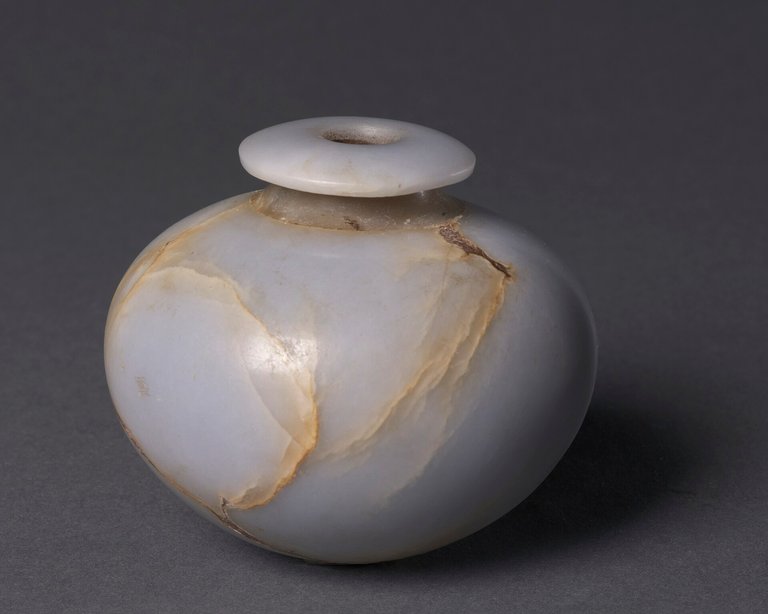
After all my hours of searching through history, I can not seem to find any origin story of how our relationship with body odor, as a society, got started. However there does seem to be common denominators amongst them all. One of these is that body odor was not simply treated as a physical problem, but also a social one.
The Romans are a good example of this. Their writings show that having an un|pleasant smell could become a reason for ridicule, particularly when it came to the smell of the arm|pits. Catullus de|scribed a man who supposedly had the smell of a goat coming from beneath his arms, while Plautus used the same comparison for comedic effect. Ovid also wrote about avoiding the “goat” smell and recommended removing underarm hair and using powders. These are evidences of social expectancy commonly found across civilizations.
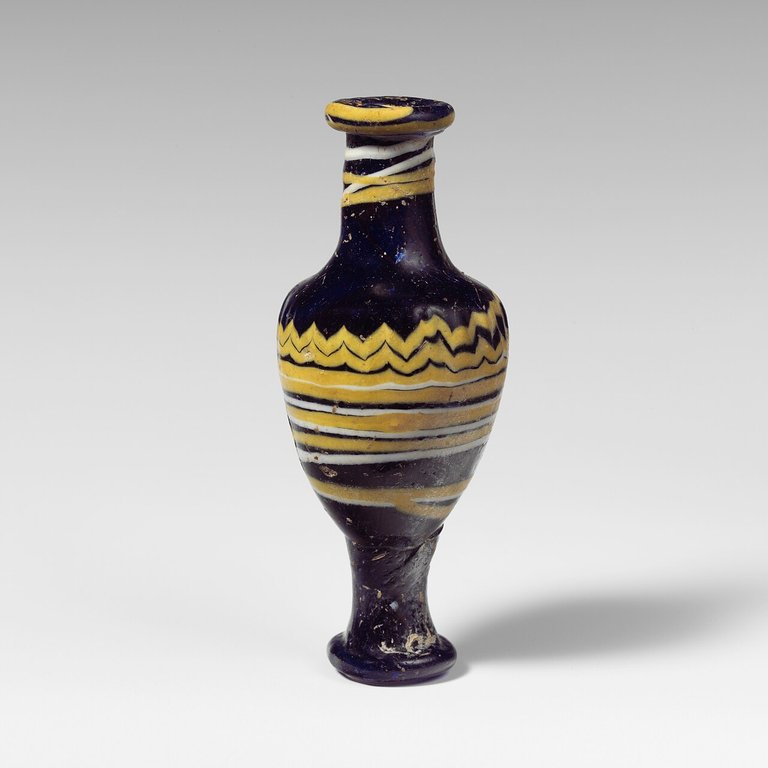
Pliny recorded several preparations intended to deal with unpleasant body odor, including mixtures of rue, aloe and rose oil, as well as other substances applied to the body. The Romans also used alumen, or alum, as a deodorizing substance, including placing alum stones in the armpits. Mayhaps this is where adding aluminum in deodorant stems from.
They were deliberately putting a substance onto the body because they did not want the body to smell a certain way, and the social consequences appear alongside the remedies. The unpleasant smell itself could become part of how someone was described, mocked, avoided, shamed or judged.
Why should we question what we put onto our body?
Because your skin is not a wall that repels harmful effects and from chemicals. What you put on to your body can have dangerous adverse effects even if the intentions are good.
If you can eat it, don't put it on your body.
Whatever you put on it can interact with your skin, remain on the surface, get absorbed to some degree, or be inhaled or transferred elsewhere. Deodorant is something many people apply directly to their skin every day, sometimes for decades.
Every day we put things on our skin constantly: soaps, shampoos, lotions, fragrances, cosmetics, sunscreens, medicines, and deodorants. Some are washed off almost immediately. Others can remain on the skin for hours and very little amount of people question what that all does to our biology.
Deodorant is particularly worth looking at because it is commonly applied directly to areas such as the armpits, often every day, and then left there throughout the day. The armpit is also a warm, moist area with a large number of sweat glands and a skin barrier that can be affected by irritation, shaving, friction, and other products.
It makes this worth understanding, especially when something is being used repeatedly over a long period of time. If we are going to deliberately put a chemical mixture onto our skin every day, simply to change the way we smell, it seems reasonable enough to know what that mixture actually contains, what those substances are doing there, and what they are doing to us on the long run.
What alternative things can I do to improve my body odor?
Some People Have All The Luck
There is a gene called ABCC11, with which a particular variant of this gene, more commonly found in east Asia, is strongly associated with reduced production of certain odor-causing compounds from apocrine secret-ions, and it also deter|mines the type of ear|wax a person produces. People with the AA genotype, at the relevant variant, generally produces much less of the precursors that skin bacteria turn into typical underarm odor.
Go figure.
Ok, But I Don't Have That Variant So What Can I Do?
For the practical side, there are several things that can affect body odor without deodorant:
Washing: removes sweat, skin oils, bacteria, and the compounds they produce. Washing the armpits and other odor-prone areas regularly is the obvious starting point.
Clothing: sweat and odor-producing compounds can remain in fabric even after the body has been washed. Changing clothes and washing them properly can therefore make a noticeable difference.
Here's a DIY recipe for making your own natural detergent that saves you on spending costs and time.
Exercise: exercise itself makes you sweat more, so it isn't an odor-reduction method by itself, but regular physical activity supports general health, and washing afterward removes the sweat and microbial byproducts.
Diet: foods can definitely influence body odor, because some compounds from food or their metabolites can eventually be excreted through sweat and other bodily fluids. Garlic, onions, alcohol, and some spices are common examples. This varies considerably between people.
Hair: underarm hair can retain sweat, oils, bacteria, and odor compounds. Removing it doesn't stop sweating, but it can make washing the area easier and may alter how much odor remains.
Skin microbiome: body odor depends heavily on the microorganisms living on the skin. Different people have a variety of differences i. microbial communities, which is one reason two people can sweat similarly, eat similarly but still smell quite differently.
Health and hormones: illness, hormonal changes, and certain metabolic conditions can change body odor. A sudden or unusual change in odor can therefore sometimes be a sign that something else has changed that may require extra attention, even emergency medical attention.
You see, there are various existing methods people can improve their odor through diet, exercise, sweat, shower, and take better care of themselves, yet, in today's modern world, body odor is still treated as something that requires a commercial product.
They used your fear to sell you a product
For thousands of years humanity has fought against body odor before they normalized detergents. The majority of these methods have been practical and healthier than the standard chemical bombs you slap in your pits nowadays.
In the early 1900s, deodorants and antiperspirants were still a very new concept. People already washed themselves and used perfumes, and many considered these new products unnecessary or even unhealthy. For the marketing department of these new products, it was all too real dilemma and something had to be changed. They had to sell time to a clock, or in other words sell water to a fish. The point is, they needed to change the perspective of the masses rather than their own product. They needed convince the fish it needs your water, to convince the clock in needs their time. In a matter of speaking.
Then came Odo-ro-no.
Odor-Oh-No!
Don't you know that you are just too stupid to know what's good for you?
Too stupid to even see why you need our product.
Be smart and classy. Buy odor-o-no and no one will call you stupid again, you dumb bitch.
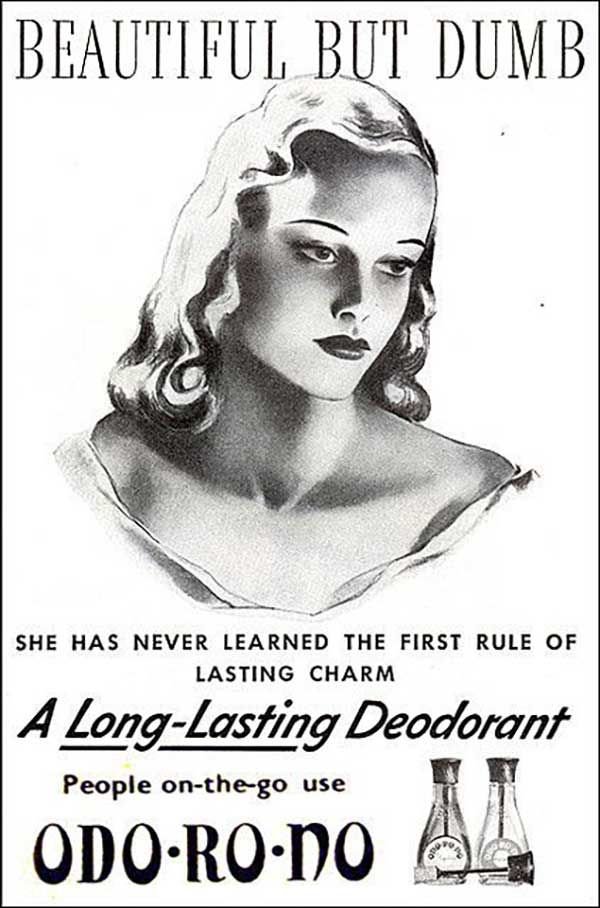
In 1919, its advertising strategy changed dramatically. An advertising survey found that many women knew about the product, but didn't believe they needed it. The solution wasn't to make the product different, so the advertising agency decided to make perspiration itself into a social problem.
The famous advertisement appeared in Ladies' Home Journal under the headline “Within the Curve of a Woman's Arm.” It suggested that a woman might unknowingly smell offensive, and that this could damage her romantic prospects. The advertisement was controversial enough to generate complaints and canceled subscriptions, but Odorono's sales rose 112% the following year.

The advertising tactic was even described as “scare copy.” The basic psychological trick was particularly nasty: you might smell bad, you might not know that you smell bad, and other people might know it but be too polite to tell you. And so advertising became focused on shaming the potential clients. More investments were made in advertising than in their own products. And it worked.
By the 1930s, the strategy was becoming even more explicit. Advertisements connected underarm odor with unpopularity, romance, employment, and social failure. One 1937 Mum advertisement essentially presented an imaginary woman as lonely, because she didn't realize she had offensive underarm odor.
Just look at these other vintage ads from the early 1900s:
You stinking out on public? Obviously nobody taught you. You must have not have had a MUM.
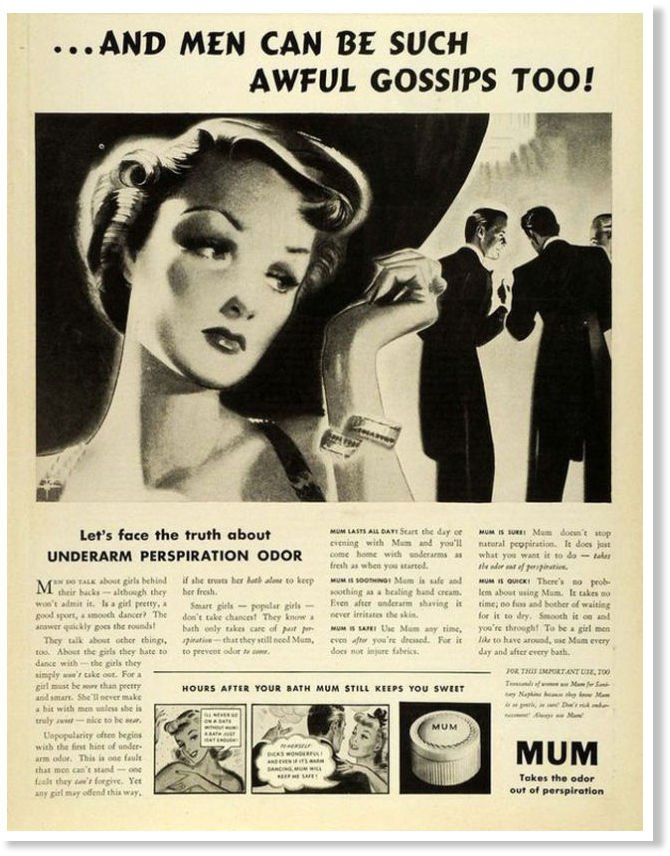
Obviously, you anti-social freaks must not have afforded deodorant. Be sure your wife doesn't become one them.
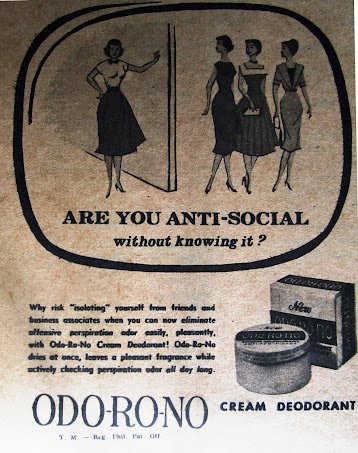
Of course, if you're still dabbing, that's so yesterday's fashion. Everyone knows sprays are the new go to product, you out of fashioned wanka.

And this wasn't isolated to one company either. Other manufacturers of many different markets copied the approach. Advertising historians describe the broader shift as advertisers identifying, or deliberately creating, personal anxieties that could then be solved by purchasing a product.
A tactic that is still very much in use today but more refined of course. Don't believe me? Ever notice commercials on how happy people are while holding a beer? Or a coca-cola bottle?
It's almost like the product itself is saying, "you ain't happy unless you have me around." "Your not pretty unless you buy our lipstick".
The thing is, people were much happier and healthier before these commercial era products really took hold, and slowly helped make you broke financially. The practical knowledge of natural remedies for these everyday needs, was quickly being out paced and replaced at the cost of your autonomy.
Before deodorant existed as a manufactured consumer product, people already had practical a large variety of ways dealing with odor: washing, bathing, changing clothes, removing hair, using water, herbs, oils, powders, diet, and simply managing the conditions that produce or retain odor. Unfortunately, much of that knowledge has effectively disappeared from ordinary modern practice, because of the commercial product becoming the default solution. Quickly, people started asking less how to manage their odor and started asking which products was best to buy instead. Thus adding to the every growing problems of waste that con|sumer|-ism brings.
The knowledge wasn't necessarily lost because it stopped working, it was lost because people stopped needing to know it. All according to plan to keep you attached to their products, until you become bankrupt out of fear.
Dependency without autonomy is a bitch.™
What are you actually buying?

People are buying a chemical formulation designed to alter a natural bio-logical process, all because they've been taught that the natural result is socially un-acceptable, and you know most people hate not fitting in their social circles. Would be a shame to be excluded because of your body odor. That's just crossing the line. Maybe so, but you don't have concede to it at the cost of your overall health.
Deodorant doesn't necessarily stop sweat. Its primary function is to change what happens to the odor, with artificial fragrances that masks it, and while, with the power of big pHARMacy, the birth of artificial anti-micro|bial ingre|die|ents can now enter|fear with the bacteria responsible for producing odor.
Antiperspirant goes further and uses, for the majority, aluminum-based active ingredients to reduce the amount of sweat reaching the skin's surface. Basically it becomes a plug on your pores, but that sweat has to go somewhere.
The product therefore isn't simply “cleanliness in a stick.” It's an engineered mixture designed to intervene in sweating, skin bacteria, odor perception, or some combination of the three. The commercial formulation contains far more than the thing advertised on the front. The active ingredient is surrounded by carriers, solvents, fragrances, preservatives, stabilizers, propellants, emollients, and other formulation ingredients depending on the product. All of which is vaguely mentioned and all too many people never question it, much less understand what it is that they are reading.
In other words, you're buying a manufactured chemical intervention into a normal biological function, packaged as a daily necessity and sold under the much simpler idea of “don't stink.” or else... Fear of social ridicule, which for the most part, has been purposely manufactured for the sake of making profits.
You, dear reader, are being manipulated and lied into purchasing their products when alternative natural methods exist and are much more healthier and less costly if you just make it yourself. All with ingredients that you can find in your own kitchen today and o ly takes a small portion of your afternoon to make.
Before we get into that, I must show you what is in your de|odo|rant/anti-per|spi|rant, how it is made, and what it is doing to your health.
What is actually in it?
Aluminum Chlorohydrate

This is the big daddy that makes antiperspirants an antiperspirant. It the main active ingredient in most widely purchased products. It's sole purpose is to stop the sweat or slow it down dramatically.
The way it works is simple enough to understand when we strip all the technical stuff away. When the aluminum Chlorohydrate mixes with the moisture from your sweat as it produces, it forms a temporary blockage in your pores, basically creating a little plug that reduces how much sweat reaches the surface of your skin.
However it doesn't stop there. Although various studies show that very little gets absorbed through the skin, over a prolonged long term period of use, it can all start adding up especially if you don't practice heavy metal detoxing regularly, which I doubt many of you actually do.
Aluminum isn't a nutrient your body needs. Once absorbed, it can enter the bloodstream, distribute into tissues, and is primarily eliminated through those poor alcoholic, ibuprofen infested kidneys of yours already operating at half capacity. Bones can also retain aluminum for long periods of time.
Aluminum has been detected in human brain tissue, including the cerebral cortex and hippocampus. Researchers have documented that aluminum can cross the blood-brain barrier and that, once inside the brain, its removal can be slow. Some studies have also found aluminum in neurons, astrocytes, and blood vessels within the brain.
The brain isn't exactly an organ you want accumulating unnecessary metals in. Aluminum has no known essential biological function in humans, yet it is capable of entering and being retained in nervous tissue. Severe aluminum exposure has produced well-documented neurological toxicity, including the historical cases of dialysis encephalopathy.
At sufficiently high systemic exposure, aluminum is known to have toxic effects, including neurological and bone effects. People with impaired kidney function are particularly important because the kidneys are the main route of elimination.
Researchers including Philippa Darbre have reported that aluminum is measurable in human breast tissue and have investigated mechanisms by which aluminum could affect breast epithelial cells. Her work reports effects including genomic instability, altered cell proliferation, oxidative damage, inflammatory responses, and interference with estrogen-related activity.
Aluminum has been investigated as a possible metalloestrogen—a metal capable of interacting with estrogen-sensitive biological systems. A 2024 review specifically examined this possibility in relation to antiperspirant exposure and breast cancer.
Darbre's earlier review discusses aluminum's reported genotoxic properties, including DNA alterations and epigenetic effects, and argues that these mechanisms warrant consideration for breast tissue exposed locally to aluminum-containing antiperspirants.
Aluminum is capable of neurotoxic effects at sufficiently high systemic exposure. Aluminum has also been detected at elevated concentrations in some Alzheimer's disease brains. The difficult question is whether aluminum contributes to the disease or accumulates as a consequence of disease; the literature remains divided on that point.
People can apply antiperspirant to the same area daily for decades. Researchers have explicitly identified widespread, long-term exposure as an area requiring investigation.
These are summaries of actual real studies. Personally, you all need to start adding fresh Cilantro to your meals more often. Seriously 😒. But this isn't about how to get heavy metal detoxing, my aim is to provide you with the method to stop the causes that are getting you poisoned. Although you should get detoxing done asap if you never have before. It will be a slow process, but it can be done.
Now, I'm not claiming that aluminum in deodorant causes breast cancer and Alzheimer's, but it definitely requires some extensive research and skepticism on your part to decide for yourself if that is what you want to risk. Or just stay on the already proven healthy natural methods of managing your body odor.
However I will say that there is enough biological evidence to ask what repeated aluminum exposure is doing, particularly because the product is deliberately applied to the same area of the body day after day.
Cyclopentasiloxane (D5)
Cyclopentasiloxane is a cyclic silicone compound, also called D5 or deca|methyl|cyclo|penta|sil|oxane. Say that 5 times fast.
In cosmetics, it functions as a carrier, solvent, emollient, and viscosity-control ingredient. In plain English, it helps the product spread smoothly over your skin and gives it that dry, silky feel.
It's also volatile. A large portion of the D5 in a leave-on product evaporates after application rather than remaining on your skin. In experiments using antiperspirant formulations on human skin, roughly 90% volatilized before being absorbed. However, i must point out that it doesn't mean that the remaining 10% is absorbed. In actuality, only about 0.05% of D5 is actually absorbed into circulation.
Is D5 itself something to be worried about?
The EU Scientific Committee on Consumer Safety concluded that D5 was safe at the concentrations reported for cosmetic use, while noting particular concerns with aerosolized applications and the possibility of D4 contamination.
D4 is octa|methyl|cyclo|tetra|sil|oxane and it matters because cyclopentasiloxane(D5) can contain traces of cyclotetrasiloxane (D4), which is classified in the EU as toxic to reproduction. That's why the SCCS specifically says D4 impurities in D5 should be kept as low as possible.
Now, a small amount in a single application doesn't necessarily sound like much, but that's also looking at exposure of one application at a time. These products are designed to be used repeatedly, often every day, for many years. So the question isn't simply how much D4 might be absorbed from one application, but how much repeated exposure adds up over time, and how quickly your body actually clears it.
That doesn't mean D4 simply piles up indefinitely in your body. The available evidence suggests that much of the absorbed material is cleared relatively quickly, but repeated exposure means you're continually introducing more. So even when the amount absorbed from each individual application is small, long-term exposure is still worth considering, especially when the ingredient exists only because the manufacturer needed a particular chemical property, in a product you're putting on your body every day.
D4 has demonstrated reproductive effects in female rats at high exposures. Whether the much lower exposure associated with consumer products can produce a comparable effect in humans has not been established.
Fragrance/Parfum
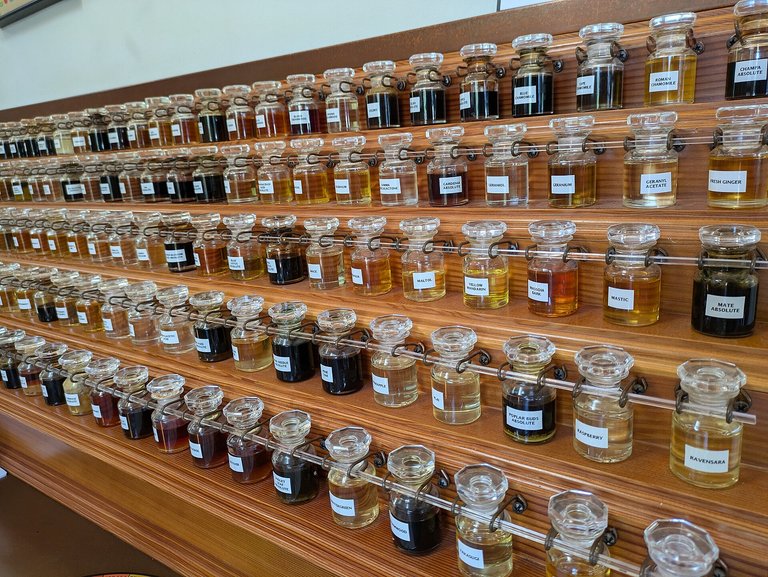
“Fragrance” / “parfum” is not one chemical. It's a catch-all cocktail and it's ingredients for it varies from product to product and is never descriptive in the labels. It's a huge rabbit hole of chemicals so I am only going to cover this section briefly.
A fragrance formulation can contain dozens or even hundreds of individual substances. IFRA's 2025 transparency list contains 3,312 fragrance ingredients plus 379 functional ingredients used to support fragrance mixtures. Those include natural substances, synthetic aroma chemicals, solvents, diluents, preservatives, antioxidants, and other functional materials.
“Fragrance” on a U.S. cosmetic label doesn't tell you the individual composition. FDA permits fragrance mixtures to be declared simply as “Fragrance” because the formulation can constitute a trade secret. In the EU, it's similar in this principle.
It's purpose has only 2 functions. To make the product smell good and to cover the smell you don't want to smell.
So deodorant doesn't necessarily make the underlying odor disappear. Part of the formula is simply to introduce another collection of volatile molecules whose smell dominates what your nose perceives. Fragrance is not merely cosmetic decoration. It can be the primary part of the deodorant's functional strategy for dealing with odor while aluminum chlorohydrates serves as the antiperspirant side of the product.
The downside is that fragrance is also one of the better-established causes of allergic contact dermatitis from cosmetics. This isn't theoretical. In one clinical study specifically examining deodorants, 20 products were tested on fragrance-sensitive eczema patients. 12 of the 20 deodorants produced eczema in the armpit during a seven-day use test.
A systematic review of European dermatitis patients found sensitization prevalence of about 6.8% for fragrance mix I and 3.6% for fragrance mix II among consecutively patch-tested dermatitis patients. That's a dermatitis population, not the general population, so don't interpret those numbers as “6.8% of everyone is allergic.”
What the hell is actually hiding behind that one word, what are all those chemicals doing, and why are we repeatedly putting an undisclosed mixture of them into our armpits just so we smell like “Fresh Mountain™” instead of ourselves?
Unfortunately that's one deep rabbit hole i don't have her luxury or time to dig into and this article is already becoming something rather large to digest.
With that said, I think we covered enough to make the point. With that said let's make some deodorant. The part you all have been patiently waiting for.
DIY NATURAL DEODORANT
The ingredients are simple and easy to mix.
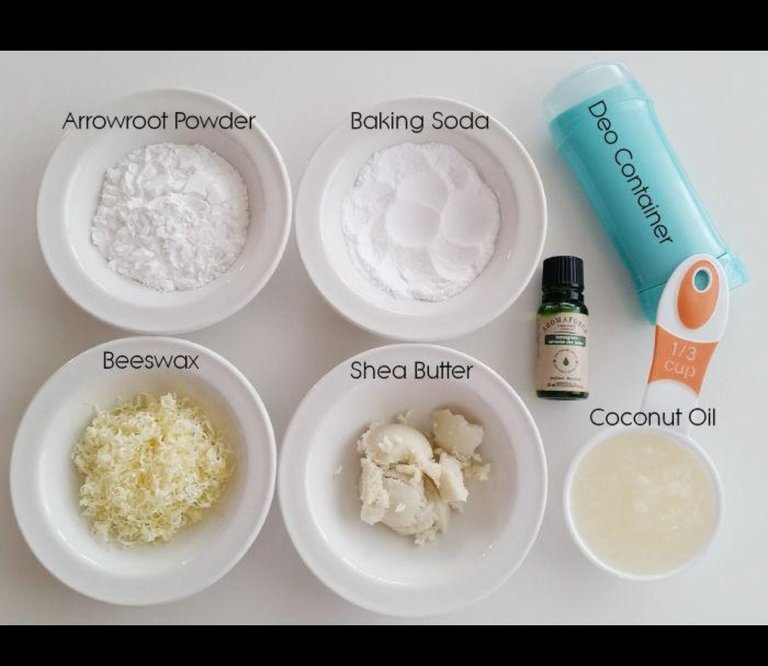
- 2 tablespoons coconut oil: this is the base of the mixture.
- 2 tablespoons baking soda: helps with odor. If you're sensitive to baking soda, use 2 tablespoons of white clay powder instead.
- 2 tablespoons cornstarch: or better yet, arrowroot starch, which helps absorb moisture and gives the mixture some body.
- 1 small spoon of beeswax: this helps turn the mixture into an actual deodorant stick. If you don't have beeswax, Vaseline works too.
- Tea tree oil: optional, if you want to add it as anti-fungal product
- Natural essential oils: optional, if you want a particular scent.
- Lemon or orange zest: also optional, if you want to experiment with a natural citrus scent.
That's basically it.
There isn't some ancient alchemical ritual you need to perform here. You don't need to add one ingredient at a time, chant three times, then add another ingredient while standing on one leg. (if you are then please record yourself making these rituals and send it over to my email so I can have a laugh.)
Just mix the ingredients together.
Once everything is mixed evenly, you need somewhere to put it. An old, empty deodorant stick works perfectly fine. Clean the old stick out properly, make sure it's dry, then put your homemade mixture inside.
Let it set and harden.
Congratulations. You just made your own deodorant instead of buying another plastic tube of mystery goop every few weeks.
And obviously, experiment with it. Everybody's skin is different. If baking soda bothers you, use the clay. If you want a particular scent, add one. If you want it harder or softer, adjust the mixture.
Congratulations, you are no longer buying the finished product. You're making it yourself.
Now let's talk numbers.
Let's say you buy the ingredients at ordinary retail prices.
Purchase cost
This is what you actually pay at the store:
- Coconut oil, 14 fl oz: $7.27
- Baking soda, 1 lb: $0.97
- Cornstarch, 16 oz: $1.97
- Beeswax, 8 oz: $11.37
Total initial purchase: $21.58
That's the money leaving your pocket, but you aren't dumping the entire package into one deodorant. unless you want to and have enough empty DEO sticks laying around...
For one batch, you're using approximately:
- 2 tablespoons coconut oil: about 1 fl oz
- 2 tablespoons baking soda: about 1 oz
- 2 tablespoons cornstarch: about 0.56 oz
- 1 teaspoon beeswax: about 0.17 oz
That gives you roughly 2.7 oz (77 g) of finished deodorant per batch, which is about the same amount as a typical 2.6 oz commercial deodorant stick.
Consumption cost
Now let's calculate what each batch actually consumes from those packages:
- Coconut oil: about $0.52
- Baking soda: about $0.06
- Cornstarch: about $0.07
- Beeswax: about $0.11
Actual ingredient cost per batch: roughly $0.76.
That's before any optional tea tree oil, essential oils, or citrus.
Now look at how far those packages actually go:
- Coconut oil: ~14 batches
- Baking soda: ~15–16 batches
- Cornstarch: ~28 batches
- Beeswax: ~47 batches
So the coconut oil is what runs out first. That means the original $21.58 purchase gives you enough ingredients to make roughly 14 batches, with some baking soda, cornstarch and beeswax left over. which I am sure you use those for other things too. So larger bulk buys will probably be better for you.
Fourteen batches consume approximately:
14 × $0.76 = $10.64
So although you initially spend $21.58, you're only consuming about $10.64 worth of ingredients to make those fourteen sticks.
Now compare that with commercial deodorant
A 2.6 oz Dove antiperspirant stick is around $7.97.
Fourteen commercial sticks would cost:
14 × $7.97 = $111.58
So for roughly the same amount of deodorant:
DIY consumption cost: ~$10.64
Commercial deodorant: ~$111.58
That's a difference of about $100.94 over fourteen sticks. maybe you could spare a fiver and support the work I do for helping you save. lol.
And here's the part that's easy to miss:
You don't have to spend another $21.58 every time you make deodorant. After those fourteen batches, you're mainly going to need more coconut oil because the other ingredients are still sitting there waiting for you.
You can also make the whole batch at once and store it in a cool enough environment. Otherwise, depending on the temperature, that shit is going to melt.
You don't need a factory to make something your body uses every day. All you need is a few cheap ingredients, a container, and about 5–10 minutes of your time.
The corporation isn't selling you some mystical substance that only a laboratory can produce. They're selling you a finished mixture of ordinary materials, it's brand and unnecessary ingredients, all packaged nicely enough that you've forgotten you could make your own.
Do you feel cheated yet?
Sources
Smithsonian Magazine — How Advertisers Convinced Americans They Smelled Bad
Aluminum and Alzheimer's Disease in the 21st Century — PubMed
European Commission — SCCS Opinion on D5 in Cosmetic Products
Photo Disclaimer
Images are used under public-use, public-domain, or applicable Creative Commons licenses.
- @yayogerardo, writer, researcher, analyst, anarchist, autonomist, Humanoid 🃏™️
Find Me
Services
Independent Research & Investigation Services
Support the work with The Worlds Most Private Currency — Monero(XMR).
XMR Adress:
86fXjLUF7W9SwGSjTtsbqq4t1LKzzypEZa1t77S5c68WF3yK9SmEfzPTtRyjUhDSk9Zn7p1ahFJT4PcKW8MN4h3QRpjx2Q5
Posted via HiveSuite
Another practical, well researched and needed post that provides simple instructions to pursue an avenue of escape from the hellworld matrix. Here's a secret the predator's don't want you to know, they're carrying out covert warfare on you via food, cosmetics and other "health and beauty" products. The goal? Eugenic depopulation played out in a long game designed to sicken, weaken and kill you off via compromising your immunity and taxing your body's internal systems. Then they make pull in obscene profits via the corrupt Rockefeller founded medical system geared for serial treatments but very few cures. The profits are baked in for repeat customers (more at junkies) hooked on petroleum -based pharmaceuticals for life.
Keep these coming, all the best!