
Relato: espejos torcidos [Esp-Eng]

En un pueblo de campo vivía una mujer llamada Carmen, había crecido entre montañas, con el olor a tierra mojada y el sonido del río casi que como única banda sonora; su mente se formó en ese paisaje, ella pensaba en ciclos, en esperas y paciencia, sembraba y sabía que nada florecía antes de tiempo.
Tras cumplir veinte años, Carmen se mudó a la ciudad, fue allí que descubrió que las personas caminaban rápido, hablaban encimadas, y dormían poco; le pareció que sus pensamientos también empezaron a moverse distinto, más alerta, más ansiosos, y fragmentados; ya no era la misma Carmen, o sí, pero pensaba de otra manera, como si el lugar le hubiera reconfigurado algo por dentro.
Con el paso de los años, llegó una pandemia, y Carmen como millones, vivió el encierro, el miedo, la pérdida; escuchó a muchos expertos decir que el mundo cambiaría, que en lo adelante seríamos más solidarios, y humanos, ella lo creyó, quiso creerlo. Pero cuando las calles se abrieron de nuevo, notó algo un poco extraño, la gente no se miraba más, se miraban menos, las conversaciones eran más cortas, y los abrazos más escasos; el egoísmo se había instalado como niebla silenciosa, cosa que nadie parecía haber decidido, simplemente ocurrió.
In a country village lived a woman named Carmen; she had grown up among mountains, with the smell of wet earth and the sound of the river almost as her only soundtrack; her mind was formed in that landscape, she thought in cycles, in waiting and patience, she planted and knew that nothing bloomed before its time.
After turning twenty, Carmen moved to the city; it was there that she discovered that people walked fast, talked over one another, and slept little; it seemed to her that her thoughts also began to move differently, more alert, more anxious, and fragmented; she was no longer the same Carmen, or yes, but she thought in another way, as if the place had reconfigured something inside her.
As the years passed, a pandemic arrived, and Carmen, like millions, lived through lockdown, fear, loss; she heard many experts say that the world would change, that from then on we would be more supportive, and human; she believed it, wanted to believe it. But when the streets opened again, she noticed something a little strange: people no longer looked at each other, they looked at each other less, conversations were shorter, and hugs scarcer; selfishness had settled in like a silent fog, something no one seemed to have decided, it simply happened.
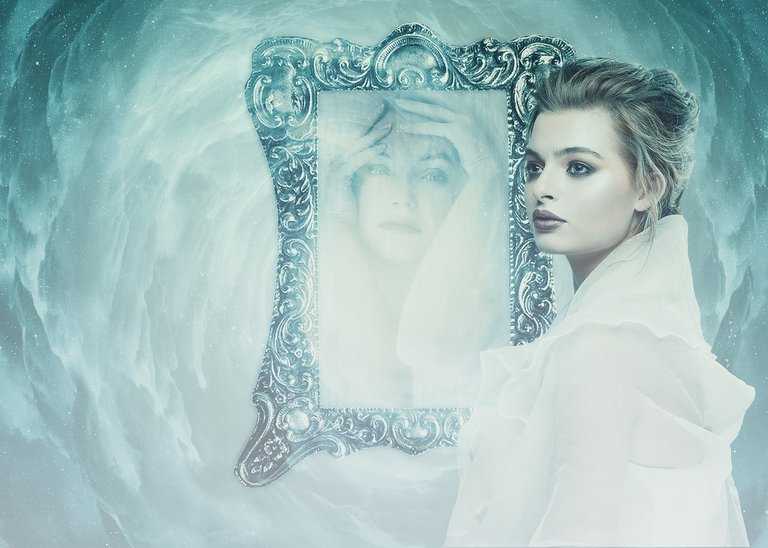
Una tarde Carmen caminaba por una feria artesanal, cuando vio un puesto de espejos, eran espejos viejos, con marcos de madera tallada, el vendedor, un anciano de ojos claros, le dijo:
—Estos espejos no reflejan lo que eres, reflejan lo que el mundo ha hecho de ti.
Carmen se miró en uno, vio a una mujer cansada, con la mirada dura, los hombros tensos, no se reconoció; se miró en otro, vio a una mujer que sonreía, con los ojos brillantes, y tampoco se reconoció; entonces entendió, que ninguna de las dos era ella, o acaso ambas lo eran, dependía del espejo, del día, del aire.
—¿Y cuál es el espejo verdadero? —preguntó Carmen.
El anciano sonrió.
—Ninguno. Los espejos solo muestran, tú eres la que decide en cuál quieres vivir.
One afternoon Carmen was walking through an artisan fair, when she saw a stand of mirrors; they were old mirrors, with carved wooden frames; the vendor, an old man with light eyes, said to her:
—These mirrors do not reflect what you are, they reflect what the world has made of you.
Carmen looked at herself in one, saw a tired woman, with a hard gaze, tense shoulders; she did not recognize herself; she looked at herself in another, saw a woman who was smiling, with bright eyes, and she did not recognize herself either; then she understood that neither of the two was her, or perhaps both were, it depended on the mirror, the day, the air.
—And which is the true mirror? —Carmen asked.
The old man smiled.
—None. Mirrors only show; you are the one who decides in which one you want to live.
Carmen compró uno pequeño, quizás el más simple, lo colgó en su casa, frente a la puerta, y cada mañana antes de salir, se detenía un segundo, no lo hacía para verse, sino para preguntarse: ¿quién quiero ser hoy? Acaso dejaría que la calle, la prisa, la noticia, el ruido, decidieran por ella, o caminaría con intención.
Ella no cambió el mundo, pero cambió su mundo, y con ello el mundo de los demás empezó a moverse también; porque Carmen saludaba primero, escuchaba sin apuro, preguntaba por la vida del vecino; y otros, tal vez sin darse cuenta, empezaron a hacer lo mismo.
No fue una revolución, fue algo más pequeño, como más grande a la vez, una decisión repetida, como esas semillas que no saben que van a ser árbol, pero igual germinan.
Carmen bought a small one, perhaps the simplest, hung it in her house, facing the door, and every morning before leaving, she paused for a second, not to look at herself, but to ask herself: who do I want to be today? Perhaps she would let the street, the hurry, the news, the noise decide for her, or she would walk with intention.
She did not change the world, but she changed her world, and with that the world of others also began to move; because Carmen greeted first, listened without haste, asked about the neighbor's life; and others, perhaps without realizing it, began to do the same.
It was not a revolution, it was something smaller, and at the same time bigger, a repeated decision, like those seeds that do not know they will become a tree, but still germinate.

Traducido con Google (versión gratuita)
Translated with Google (free version)
Gracias por su visita
Thank you for your visit
Posted Using INLEO
Un.esieho con un poder muy especial, un poder que puede hacer unir a la gente que cada día se separa más y más. Muy buen trabajo.
Gracias por compartir tu historia con nosotros.
Excelente noche.
Agradecido con sus palabras.
Saludos
No sabía lo que necesitaba un espejo nuevo (o al menos distinto) hasta este momento. Nueva necesidad desbloqueada, ja
Buenísimo tu relato. Voy a fijarme mejor donde me reflejo y lo que reflejo a los demás
Un abrazo!
Gracias por comentar.
Saludos
Esta publicación ha recibido el voto de Literatos, la comunidad de literatura en español en Hive y ha sido compartido en el blog de nuestra cuenta.
¿Quieres contribuir a engrandecer este proyecto? ¡Haz clic aquí y entérate cómo!
Gracias por su apoyo
Has sido votado por
PROYECTO ENLACE
'Conectando Ideas y Comunidades'
PROYECTO ENLACE es un proyecto de curación de habla hispana enfocado en recompensar contenido de calidad y apoyar autores en su proceso de crecimiento en HIVE.
Creemos y apostamos por el futuro de esta gran plataforma, y estamos muy emocionados de poder hacerla crecer junto a esta comunidad. Así que te invitamos a publicar en nuestra COMUNIDAD y estar atento a todas las actividades que tenemos preparadas y que estaremos publicando en breve.
¿QUIERES AUTOMATIZAR TUS GANANCIAS DE CURACIÓN? SE PARTE DEL PROYECTO ENLACE APOYANDO A NUESTRO TRAIL EN HIVE.VOTE INGRESA AQUÍ PARA CONOCER LOS DETALLES.
¿QUIERES INVERTIR ENLACE? DESCUBRE COMO HACERLO Y GENERAR INGRESOS DE FORMA SEMANAL MEDIANTE TU DELEGACIÓN DE HP AQUÍ TE EXPLICAMOS COMO.
Te invitamos a participar en nuestro servidor de Discord: https://discord.gg/3S9y7BbWfS
Atentamente
EQUIPO ENLACE 2026