
The Thirteen Nights of Þrastalundur - Ger/Eng
An icelandic creepy Christmas story in thirteen parts. German translation further below.
The Thirteen Nights of Þrastalundur
1. Stekkjastaur – The Sheep Tormentor
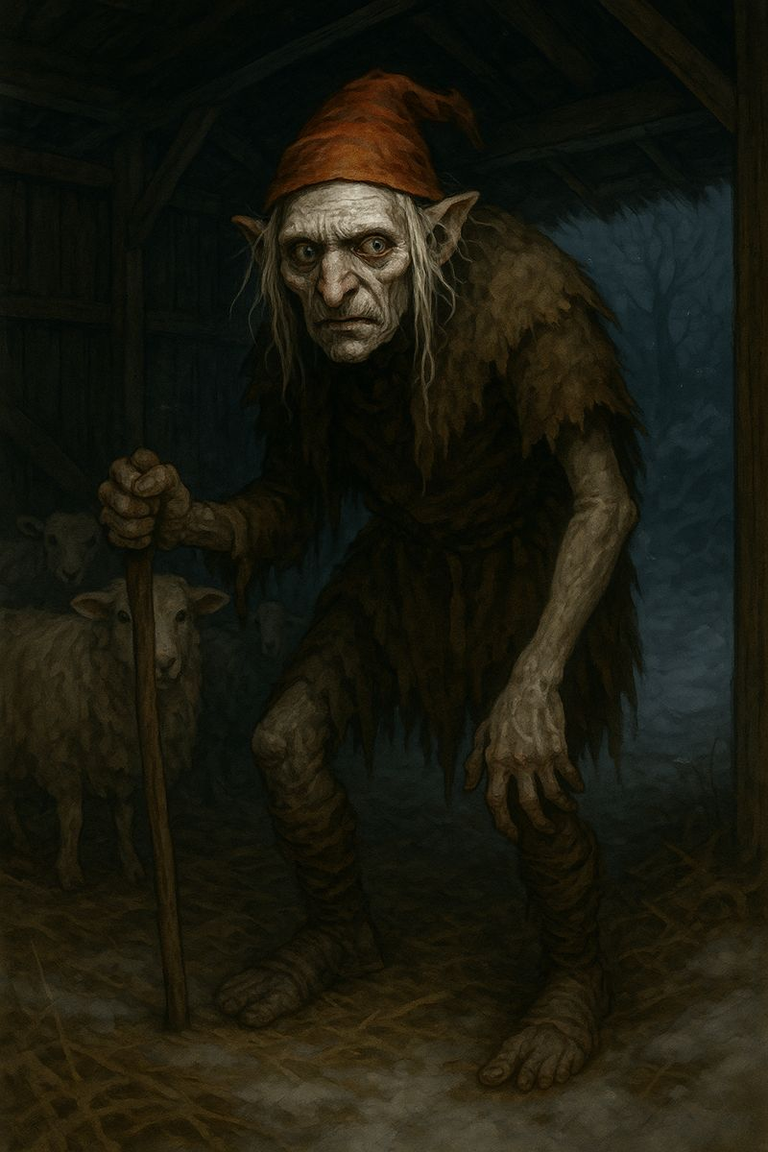
The storm howled through the valley as Jón entered the barn. The sheep huddled together fearfully. Something scurried among the shadows – limping, with gnarled legs. When Jón raised his lantern, he saw him: pale gray skin, long fingers, glassy eyes.
"Stekkjastaur," the old farmer's wife whispered in the morning. "He came to smell the first blood of winter."
Beside the sheep lay only wool – and not a drop of blood.
2. Giljagaur – The Canyon Lurker
On the second night, the milk pails were found empty, the buckets overturned. Mist drifted from the canyon like the breaths of a creature.
Ásta swore she saw a gaunt figure rise from the crack—dripping with milk, smiling with black teeth.
The cows died that night. No one ever spoke the name "Giljagaur" aloud again.
3. Stúfur – The Tiny One
Children heard giggling through the walls. A tiny shadow with sparkling eyes crept through the kitchen.
When dawn broke, the pan was empty—and the baby in the cradle was cold.
"Too small to grasp," said the priest. "But big enough to kill."
Stúfur had claimed his feast.
4. Þvörusleikir – The Spoon-Licker
Old Sigrid's house smelled of death and wood smoke. At night, the sound of slow licking of wood could be heard.
She found him the next morning: a tall, thin troll with a blue tongue curled around the soup spoon.
He looked at her.
And smiled.
5. Pottaskefill – The Pot Scraper
Fire was no longer allowed in the village. Because every time someone cooked, he appeared.
Scratch marks on pots, black soot, and the smell of burnt meat.
They found only the pot—and something that looked like skin, melted to the rim.
6. Askasleikir – The Bowl Licker
The children no longer put their food under the bed.
But Askasleikir still crawled out from under there.
A thin arm reached for the plate, then for the leg, then—silence.
When they heard the mother scream, there was only the smell of iron and salt in the room.
7. Hurðaskellir – The Door Slammer
The doors slammed so loudly that night that no one could sleep.
Every time they fell, someone disappeared.
At dawn, seven houses were empty.
And a finger hung on each door—caught, like a seal.
8. Skyrgámur – The Skyr Eater
The supply of skyr had run out. Only an open clay pot remained—and a deep tooth imprint.
The villagers found the blacksmith dead, his face smeared white.
His chest was open. Where his heart should have been, a residue of skyr clung.
9. Bjúgnakrækir – The Sausage Thief
Smoke rose from the chimneys, but no one smelled meat.
The sausages that hung above the hearth were gone—and so were the children who played there.
Later, they were found in the trees. On hooks.
Bjúgnakrækir was hungry.
10. Gluggagægir – The Window-Gazer
No one dared leave their windows uncovered anymore.
But sometimes, deep in the night, eyes – yellow as rotting ice – could be seen peering inside.
Anyone who returned the gaze was found with a broken neck, their eyes wide open.
"He takes what looks at him," they said.
And Gluggagægir saw a lot.
11. Gáttaþefur – The Door-Sniffer
He came with the north wind. A huge nose that skimmed across the ground, like an animal on a trail.
He smelled of pastries – and found meat instead.
When they found the baker, his body had been hollowed out.
His own scent had betrayed him.
12. Ketkrókur – The Butcher's Hook
The bells tolled at midnight when a metallic clang echoed through the village.
A hook, dripping with blood, swung through the darkness.
No one saw who wielded it—but the next morning, the village elder hung from the butcher's beam.
Her heart lay neatly on a plate.
Ketkrókur was satiated.
13. Kertasníkir – The Candle Thief
On the last night before Christmas, no one dared to breathe.
But the boy Einar wanted to see light—he lit a candle.
A shadow emerged from the darkness.
Kertasníkir, pale and gaunt, took the candle—and with it, the flame of his life.
When the sun rose, the village was silent.
Only smoke rose above the hills—and 13 tracks in the snow.
🕯️ Epilogue:
They say that Christmas is no longer celebrated in Þrastalundur.
But those who listen closely as the wind sweeps through the fjords will hear soft giggling – thirteen voices counting:
“One… two… three…”
Until the year grows dark again.
Die 13 Nächte von Þrastalundur
1. Stekkjastaur – Der Schafquäler
Der Sturm heulte durch das Tal, als Jón den Stall betrat. Die Schafe drängten sich ängstlich aneinander. Zwischen den Schatten huschte etwas – hinkend, mit knorrigen Beinen. Als Jón die Laterne hob, sah er ihn: blassgraue Haut, lange Finger, glasige Augen.
„Stekkjastaur,“ flüsterte die alte Bäuerin am Morgen. „Er kam, um das erste Blut des Winters zu riechen.“
Neben den Schafen lag nur Wolle – und kein Tropfen Blut.
2. Giljagaur – Der Schluchtenlauerer
In der zweiten Nacht fand man die Milchkübel leer, die Eimer umgestoßen. Aus der Schlucht wehte Nebel wie Atemzüge einer Kreatur.
Ásta schwor, sie habe eine hagere Gestalt gesehen, die sich aus der Spalte erhob – tropfend vor Milch, lächelnd mit schwarzen Zähnen.
Die Kühe starben in jener Nacht. Niemand sprach mehr den Namen „Giljagaur“ laut aus.
3. Stúfur – Der Winzling
Kinder hörten Kichern zwischen den Wänden. Ein winziger Schatten mit funkelnden Augen schlich durch die Küche.
Als der Morgen graute, war die Pfanne leer – und das Baby in der Wiege kalt.
„Zu klein zum Greifen,“ sagte der Pfarrer. „Aber groß genug, um zu töten.“
Stúfur hatte sich seinen Schmaus geholt.
4. Þvörusleikir – Der Löffellecker
Im Haus der alten Sigrid roch es nach Tod und Holzrauch. In der Nacht hörte man das langsame Schlecken an Holz.
Sie fand ihn am nächsten Morgen: Ein langer, dürrer Troll mit blauer Zunge, die sich um den Suppenlöffel wand.
Er sah sie an.
Und lächelte.
5. Pottaskefill – Der Topfschaber
Im Dorf war kein Feuer mehr erlaubt. Denn jedes Mal, wenn jemand kochte, kam er.
Kratzspuren an Töpfen, schwarzer Ruß, und der Geruch verbrannten Fleisches.
Sie fanden nur den Topf – und etwas, das aussah wie Haut, am Rand festgeschmolzen.
6. Askasleikir – Der Schüssellecker
Die Kinder stellten ihr Essen nicht mehr unter das Bett.
Aber Askasleikir kroch trotzdem darunter hervor.
Ein dünner Arm griff nach dem Teller, dann nach dem Bein, dann – Stille.
Als man die Mutter schreien hörte, war nur der Geruch von Eisen und Salz im Raum.
7. Hurðaskellir – Der Türknaller
Die Türen schlugen in jener Nacht so laut, dass niemand schlafen konnte.
Jedes Mal, wenn sie fielen, verschwand jemand.
Beim Morgengrauen waren 7 Häuser leer.
Und an jeder Tür hing ein Finger – eingeklemmt, wie ein Siegel.
8. Skyrgámur – Der Skyr-Fresser
Der Vorrat an Skyr war aufgebraucht. Nur noch ein offener Tonkrug stand da – und ein tiefer Abdruck von Zähnen.
Die Dorfbewohner fanden den Schmied tot, das Gesicht weiß verschmiert.
Seine Brust war geöffnet. Wo sein Herz sein sollte, klebte ein Rest Skyr.
9. Bjúgnakrækir – Der Wurstdieb
Rauch stieg aus den Schornsteinen, aber niemand roch Fleisch.
Die Würste, die über dem Herd hingen, waren fort – und die Kinder, die dort spielten, ebenso.
Später fand man sie in den Bäumen. An Haken.
Bjúgnakrækir hatte Hunger.
10. Gluggagægir – Der Fensterstarrer
Niemand wagte mehr, die Fenster unbedeckt zu lassen.
Doch manchmal, tief in der Nacht, sah man Augen – gelb wie faulendes Eis – die hineinsahen.
Wer den Blick erwiderte, wurde gefunden: mit gebrochenem Nacken, die Augen weit geöffnet.
„Er nimmt, was ihn ansieht,“ sagte man.
Und Gluggagægir sah viel.
11. Gáttaþefur – Der Türschnüffler
Er kam mit dem Nordwind. Eine riesige Nase, die über den Boden fuhr, wie ein Tier auf der Spur.
Er roch nach Gebäck – und fand stattdessen Fleisch.
Als sie den Bäcker fanden, war sein Leib ausgehöhlt.
Sein eigener Duft hatte ihn verraten.
12. Ketkrókur – Der Fleischerhaken
Die Glocken läuteten zur Mitternacht, als ein metallisches Klirren durch das Dorf hallte.
Ein Haken, tropfend vor Blut, schwang durch die Dunkelheit.
Niemand sah, wer ihn führte – doch am nächsten Morgen hing die Dorfälteste am Fleischerbalken.
Ihr Herz lag ordentlich auf einem Teller.
Ketkrókur war satt.
13. Kertasníkir – Der Kerzenräuber
In der letzten Nacht vor Weihnachten wagte niemand mehr zu atmen.
Doch der Junge Einar wollte Licht sehen – er zündete eine Kerze an.
Ein Schatten trat aus der Dunkelheit.
Kertasníkir, bleich und hager, nahm die Kerze – und mit ihr die Flamme seines Lebens.
Als die Sonne aufging, war das Dorf still.
Nur Rauch über den Hügeln – und 13 Spuren im Schnee.
🕯️ Epilog:
Man sagt, in Þrastalundur wird kein Weihnachten mehr gefeiert.
Doch wer genau hinhört, wenn der Wind durch die Fjorde streicht, hört leises Kichern – dreizehn Stimmen, die zählen:
„Eins… zwei… drei…“
Bis das Jahr wieder dunkel wird.
Thanks for reading, voting and commenting.


 [email protected]
Images and screenshots are from me or AI generated
Posted Using INLEO
https://www.reddit.com/r/MerryChristmas/comments/1pxjr8q/the_thirteen_nights_of_þrastalundur_gereng/
This post has been shared on Reddit by @chaosmagic23 through the HivePosh initiative.
Good time in this blog, I had to translate it but it was good blog
You got reblogged, liked and great content keep it up
Why did you have to translate it? It was in English and German.
Thanks for reblogging. 🙏
!BBH !ALIVE
@chaosmagic23, I'm refunding 0.259 HIVE and 0.026 HBD, because there are no comments to reward.